

DTP Pharmacy Services, Medical Device Translation, Healthcare Localization, and Everything in Between
Quick question. Are you one of those people who like watching top translation fails in films or best localization memes? At devabit, we like our documentation well-done, not medium-rare, but how about the life sciences DTP? A medication label can be translated correctly and still fail the patient, the dosage table may shift after translation, a warning may move to the next page, and right-to-left language may display in the wrong direction. Or a few short answers on why DTP pharmacy services matter. In this article, we break down why desktop publishing services for pharmacy and healthcare are not only about appealing packaging, multilingual accessibility, and high-quality translation. In alliance with our Executive Director of Production, Localization, DTP, QC & 3D Modeling Expert, Iryna Diakiv, we gathered all the best-in-class insights on DTP pharmacy services, answered the most frequently asked questions, and shared expert advice on how not to fall for the most common localization mistakes. So read along to explore the concepts of DTP pharmacy services, medical device translation, healthcare localization, and everything in between with devabit.
What Are DTP Pharmacy Services?
DTP pharmacy services are the layout, formatting, and production services used to prepare translated pharmacy and healthcare materials for real-world use.
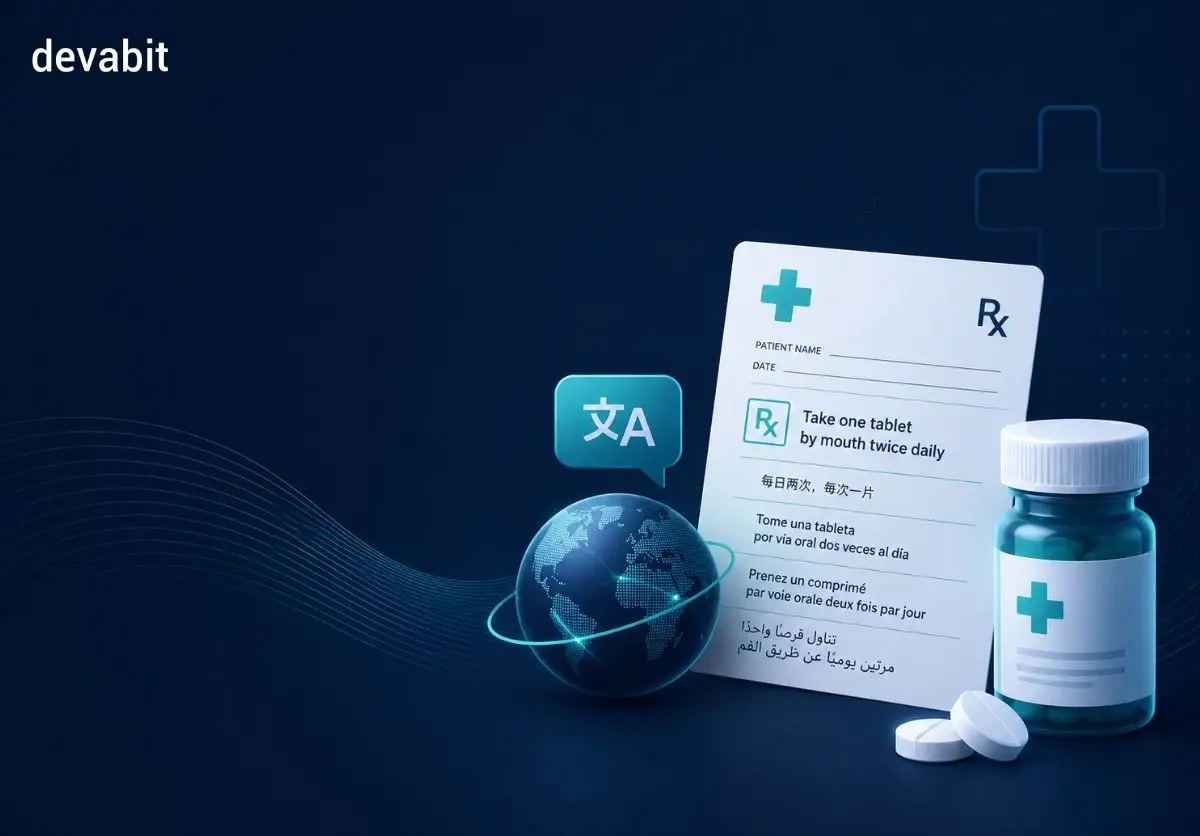
They turn translated text into a finished document, label, leaflet, package insert, brochure, PDF, app screen, or print-ready files. For pharmacies, this can include prescription labels, medication guides, dosage schedules, vaccine information sheets, refill instructions, patient leaflets, drug interaction warnings, OTC medicine materials, pharmacy brochures, and multilingual signage.
For pharmaceutical and healthcare brands, it may include packaging artwork, patient education materials, regulatory documents, training guides, and digital content. Despite common misconceptions, the value of DTP pharmacy services is not just cosmetic or aesthetic. In healthcare, a simple dosage table, warning box, icon, line break, and font size can affect how quickly and accurately a patient understands what to do. And if the layout fails, the translation may not be enough. And sometimes that is literally a matter of life and death.
Translation, Localization, and DTP: What Is the Difference?
Many healthcare organizations use the terms translation, localization, and DTP as if they are interchangeable. In fact, they are connected, but they solve different problems. Medical translation services focus on converting medical content from one language into another while preserving meaning, terminology, and clinical accuracy. This is essential for patient leaflets, hospital forms, clinical trial documents, medical reports, and pharmaceutical content.
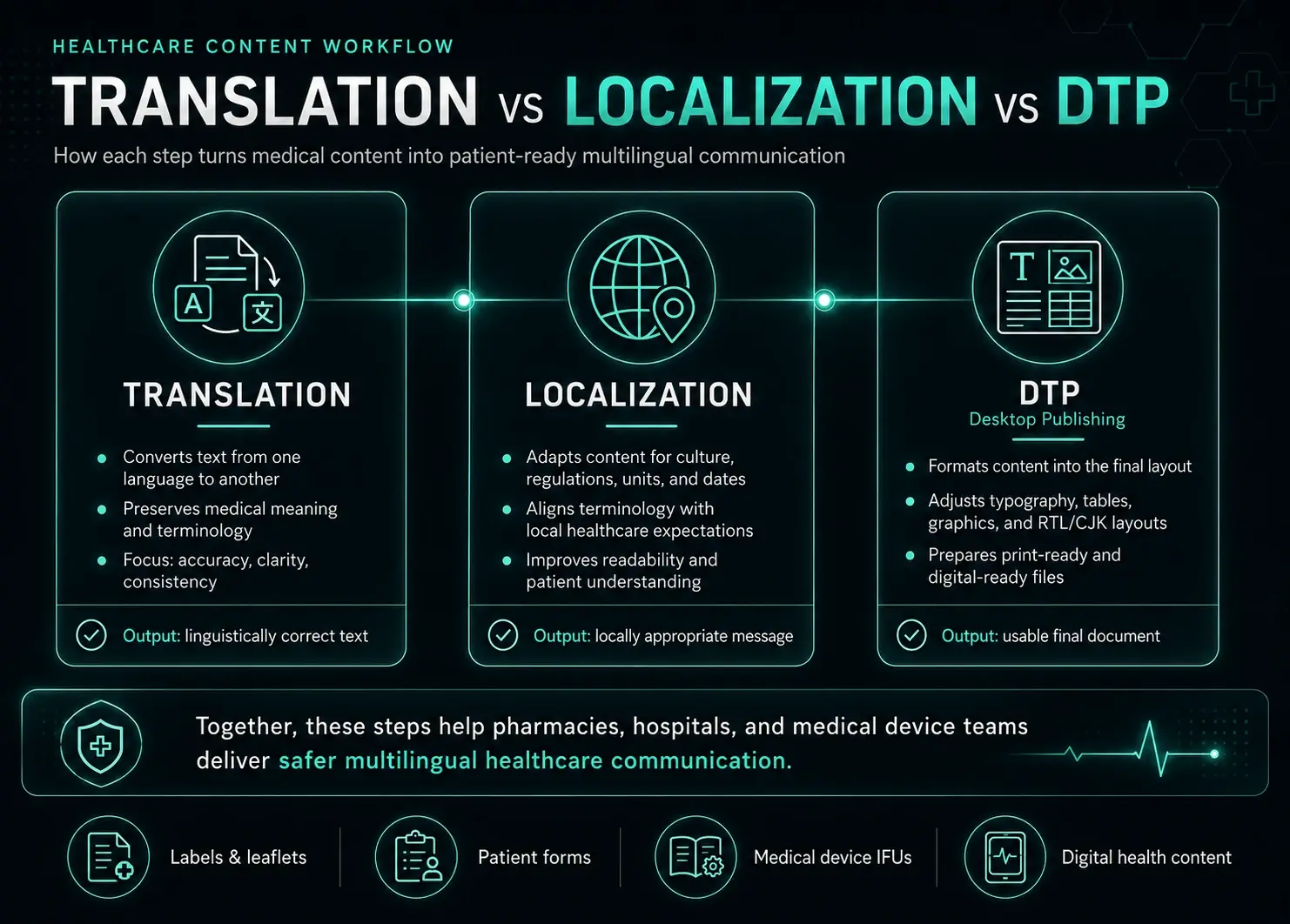
Meanwhile, medical localization goes further. It adapts content for the target audience's language, culture, medical terminology, regulatory expectations, measurement systems, date formats, literacy level, and healthcare context. A localized patient leaflet should not simply sound translated. It should feel natural, trustworthy, and usable for the people who receive it.
Multilingual DTP services handle the visual and technical side. They make sure translated and localized content fits correctly into the final format. This includes typography, spacing, tables, images, icons, page flow, right-to-left formatting, print specifications, accessible PDFs, and final layout QA.
In short, translation makes the words accurate, localization makes the message appropriate, and DTP makes the final material usable for both patients and providers. Now that we are familiar enough with the terminology of translation, localization, and DTP, let's talk about their significance for the healthcare and pharmacy industry.
Why Medical Localization Matters in Pharmacy and Healthcare
Healthcare is full of high-risk communication. Patients are asked to follow dosage instructions, recognize side effects, prepare for procedures, use devices, give consent, and understand warnings. These tasks become harder when the information is not available in a language or format the patient can use. According to the KFF survey, in the US, about 26 million people have limited English proficiency, representing around 8% of people ages five and older. That number alone shows why healthcare translation services and healthcare localization are not niche services, but a part of everyday healthcare access.
Medical localization also supports health literacy. The World Health Organization notes that organizations can improve health literacy by strengthening communication and access to culturally and linguistically appropriate health information and services. For pharmacies and healthcare providers, that means the goal is not only to translate the file, but also to help patients understand what the information means and how to act on it.
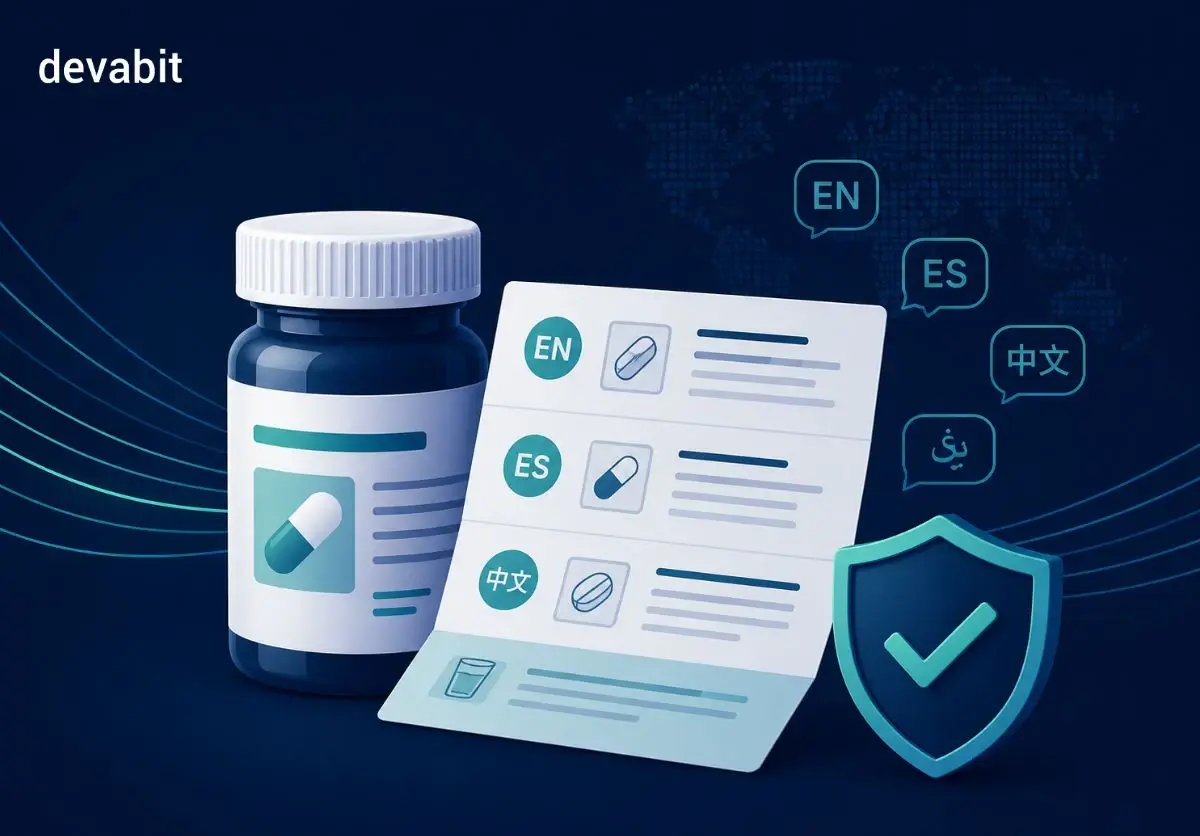
Good medical localization considers details such as local drug naming conventions, decimal separators, dosage units, reading direction, cultural expectations, patient literacy, accessibility, and the difference between professional medical language and patient-friendly language. This is where DTP pharmacy services become especially useful: they preserve these localized choices in the final layout.
How DTP Pharmacy Services Support Patient Safety
Patient safety is usually discussed in terms of clinical care, but written information is part of care too. A patient may receive accurate instructions from a pharmacist, then rely on a label, leaflet, app notification, or printed handout at home. If that material is confusing, safety can suffer. Research on language barriers shows why this matters. A study of adverse events in US hospitals found that 49% of adverse events involving patients with limited English proficiency involved physical harm, compared with 30% for English-proficient patients. It also found that adverse events for limited-English-proficient patients were more likely to involve communication errors.
AHRQ similarly notes that adverse events affecting LEP patients are often communication-related and more likely to result in serious harm. This is exactly where DTP pharmacy services can make a difference. They help ensure that translated materials remain clear after formatting. A multilingual DTP specialist checks whether dosage rows still align, warnings remain visible, symbols render correctly, line breaks do not distort medical terms, and target-language text fits without shrinking the font into unreadability.
For example, German or French text may expand and overflow a label designed for English. Arabic and Hebrew require right-to-left layout logic. Chinese, Japanese, and Korean need appropriate line breaks and fonts. Some scripts require careful font support to avoid missing characters or broken rendering. Even a small layout issue can make a pharmacy document harder to read. In healthcare, formatting is part of the message.
And that is the exact point that makes standard DTP services different from DTP services for life sciences, pharma, and healthcare. It is not just about the visual appeal and accurate translation, but about your patients' safety, reputation, and brand recognition.
Pharmacy Translation Services: Key Materials That Need Expert Handling
Pharmacy translation services cover more than medicine names. They also involve patient-facing content that must be accurate, readable, and often space-constrained. The most common pharmacy materials include prescription labels, medication instructions, patient information leaflets, side effect summaries, drug interaction warnings, refill reminders, vaccine forms, consent materials, OTC medicine instructions, patient counseling handouts, pharmacy website content, mobile app screens, email reminders, and SMS notifications. These materials need careful handling because pharmacy communication often happens quickly.
Patients may read instructions while standing at a counter, caring for a child, managing multiple prescriptions, or navigating a stressful diagnosis. The content has to be understandable at first glance. The FDA recognizes several types of patient labeling, including Medication Guides, Patient Package Inserts, and Instructions for Use.
Medication Guides are required for certain prescription drug products that raise serious public health concerns and require FDA-approved patient information. That regulatory context reinforces the point: pharmacy content is the information patients may rely on to make vital health decisions. And strong DTP pharmacy services make pharmacy translation services more effective by ensuring the final document is not only accurate, but also readable, consistent, and production-ready, making the documentation a win-win for both patients and providers.
Healthcare Translation Services for Hospitals, Clinics, and Public Health Providers
Pharmacies are only one part of the healthcare communication chain. At the same time, hospitals, clinics, laboratories, insurers, public health agencies, and telehealth providers also depend on healthcare translation services. Typical materials include consent forms, discharge instructions, patient intake forms, appointment reminders, insurance documents, patient portal content, public health announcements, emergency instructions, test preparation guides, aftercare sheets, and multilingual signage.
Here, healthcare localization is especially important because patients interact with these materials at different moments: before care, during care, after discharge, and during long-term treatment. A literal translation may not be enough if the document uses unfamiliar medical terms, culturally inappropriate examples, unclear instructions, or a layout that does not work in the target language.
For public health and hospital settings, multilingual communication is also connected to access. US civil rights guidance under Section 1557 emphasizes meaningful access for individuals with limited English proficiency in covered health programs and activities. That makes healthcare localization both a communication priority and a compliance consideration.
Medical Device Translation Services and DTP: When Layout Becomes Critical
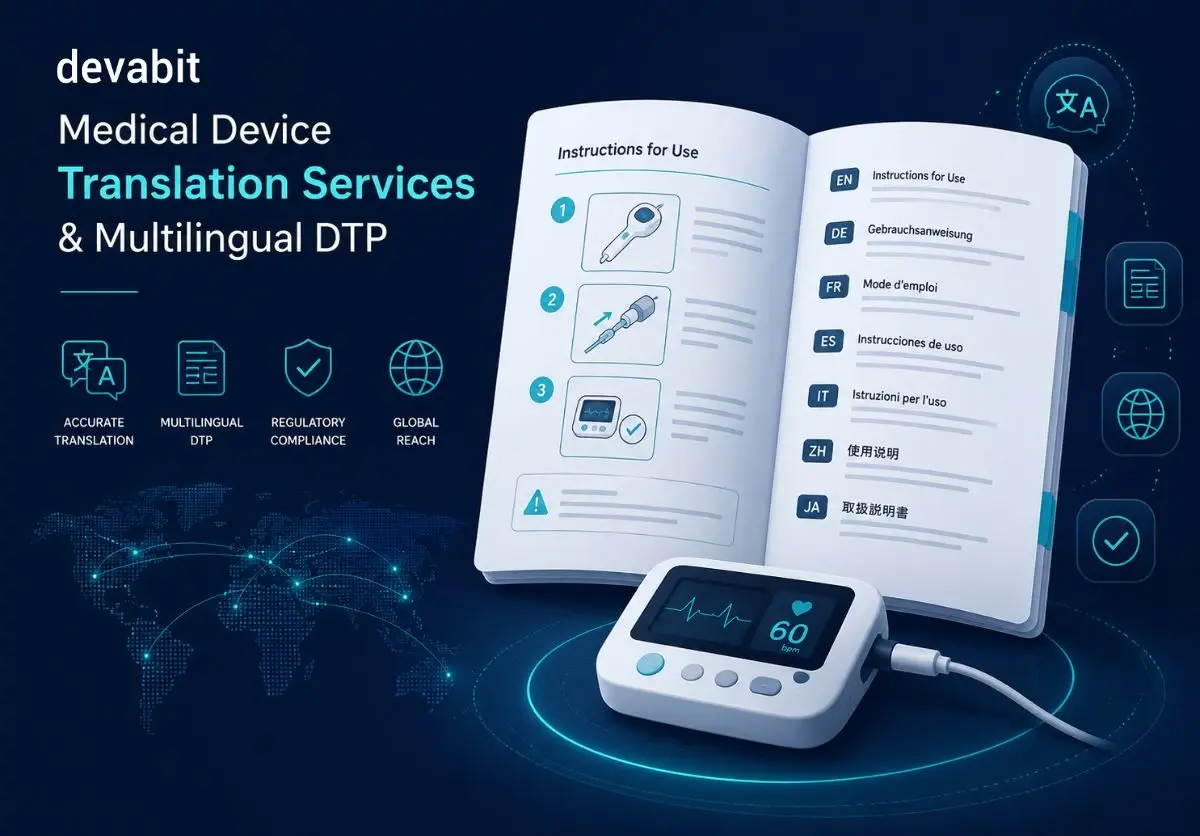
Medical device translation is closely connected to DTP pharmacy services because device content often combines text, diagrams, icons, warnings, screenshots, and step-by-step instructions. A translated IFU or user manual must preserve not only the meaning of the text, but also the relationship between words and visuals.
Common medical device materials include Instructions for Use, labels, quick-start guides, user manuals, software interfaces, packaging inserts, safety warnings, training materials, maintenance guides, and field safety notices.
The European Commission maintains MDR and IVDR language requirement tables to help medical device and in vitro diagnostic manufacturers understand language requirements for information and instructions that accompany devices in specific countries. The tables also address GUI language requirements, including apps. This is why multilingual DTP services are so important for medical devices. A warning icon must still match the right instruction, a screenshot must correspond to the localized interface, and a numbered procedure must not break across pages in a way that confuses the user.
When medical device translation services and DTP work together, the final content becomes easier to follow and safer to use.
DTP Pharmacy Services and Compliance
Compliance is one of the main reasons why pharmacies, healthcare providers, pharmaceutical companies, and medical device manufacturers cannot treat translation and DTP as simple production tasks. In regulated healthcare environments, multilingual content must do more than look polished. It must be accurate, readable, traceable, secure, and suitable for the market where it will be used.
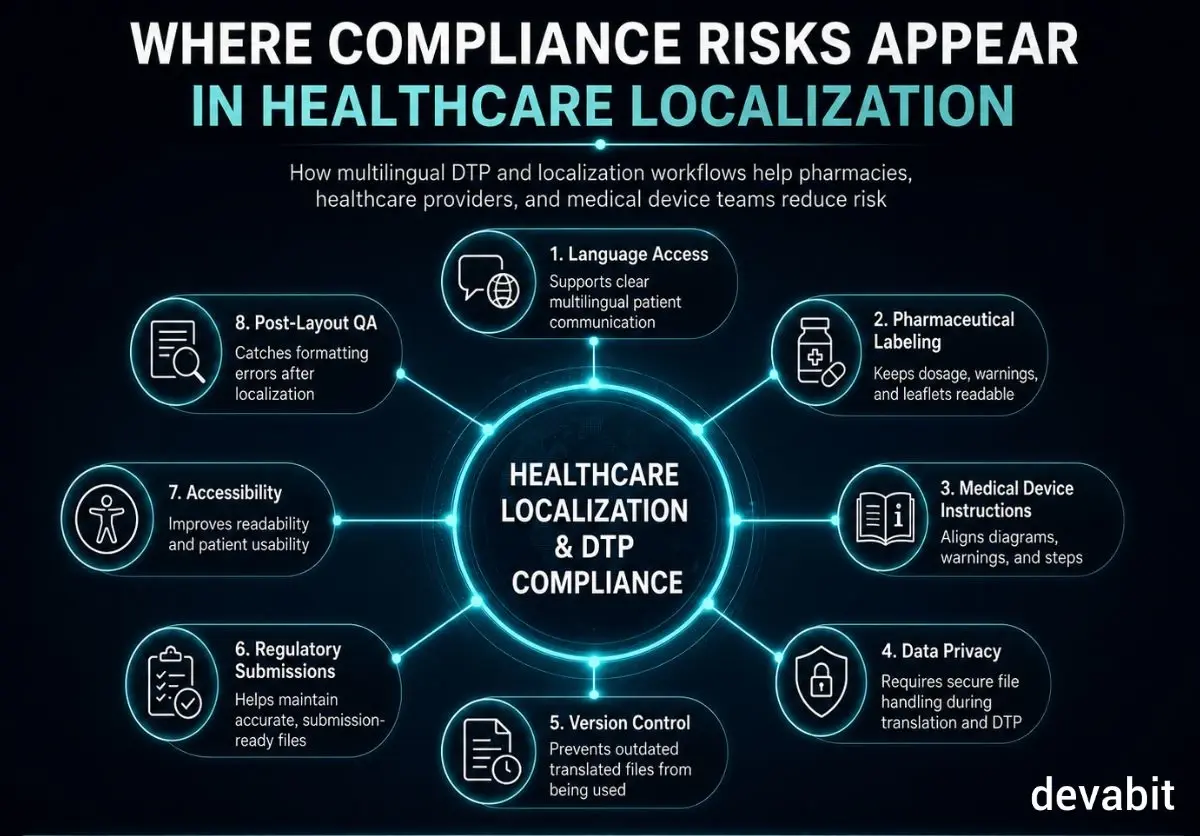
One major compliance issue is language access. Healthcare organizations often serve patients who do not speak the dominant language of the country fluently. For these patients, translated and localized materials can be essential to informed consent, medication adherence, discharge planning, and safe use of medical products.
Healthcare translation services and healthcare localization help organizations provide information in a language patients can understand, while multilingual DTP services make sure the final document remains readable and usable after translation.
Another key compliance concern is pharmaceutical labeling and patient information. Medication guides, package leaflets, labels, dosage instructions, and safety warnings must be clear, consistent, and easy to follow. Medical localization supports this by adapting terminology, units of measurement, date formats, dosage conventions, and patient-facing wording. But localization alone is not enough. DTP pharmacy services are needed to preserve the structure and visual hierarchy of the final material so that patients can quickly identify instructions, contraindications, side effects, and emergency warnings.
Compliance also affects business outcomes. Poorly managed medical translation services, healthcare localization, and multilingual DTP services can slow down product launches, delay regulatory submissions, create patient safety risks, and damage your company's trust. For medical device companies and pharmaceutical brands, a formatting or localization problem can affect market access. For pharmacies and hospitals, unclear multilingual materials can affect patient experience, adherence, and legal defensibility.
The safest approach is to treat DTP pharmacy services as part of a controlled healthcare communication workflow. Translation, medical localization, DTP, security, review, and documentation should work together from the start.
What a Reliable Medical Localization and DTP Workflow Looks Like
A strong workflow starts before translation begins. First, the DTP team reviews the source files, audience, format, regulatory context, and risk level. A pharmacy poster, a package leaflet, and a medical device IFU should not follow the same quality path.
Next comes terminology preparation. Approved glossaries, product names, dosage terms, contraindications, and recurring phrases should be aligned before translation. Then qualified linguists handle the medical translation services, followed by editing, review, and medical localization.
After that, multilingual DTP services bring the content into the final format. This may involve Adobe InDesign, Illustrator, Word, PDF, XML, Figma, CMS exports, or other file types. The DTP team adapts layout, typography, tables, graphics, spacing, page flow, and technical specifications for every language.
The most important step comes after layout: post-DTP linguistic QA. Reviewers check the final file, not just the translated text. They look for missing content, broken characters, incorrect line breaks, layout shifts, table errors, misplaced warnings, inconsistent terminology, and problems with print or digital output. Reliable DTP pharmacy services should end with final technical checks, version control, and delivery of files that are ready to use.
This is where devabit can help. Our leading desktop publishing company provides desktop publishing, localization, and translation support designed to help companies manage multilingual content more efficiently. Our DTP and QC specialists support translation and localization teams by preparing files, managing layouts, validating final documents, and helping deliver publication-ready materials.
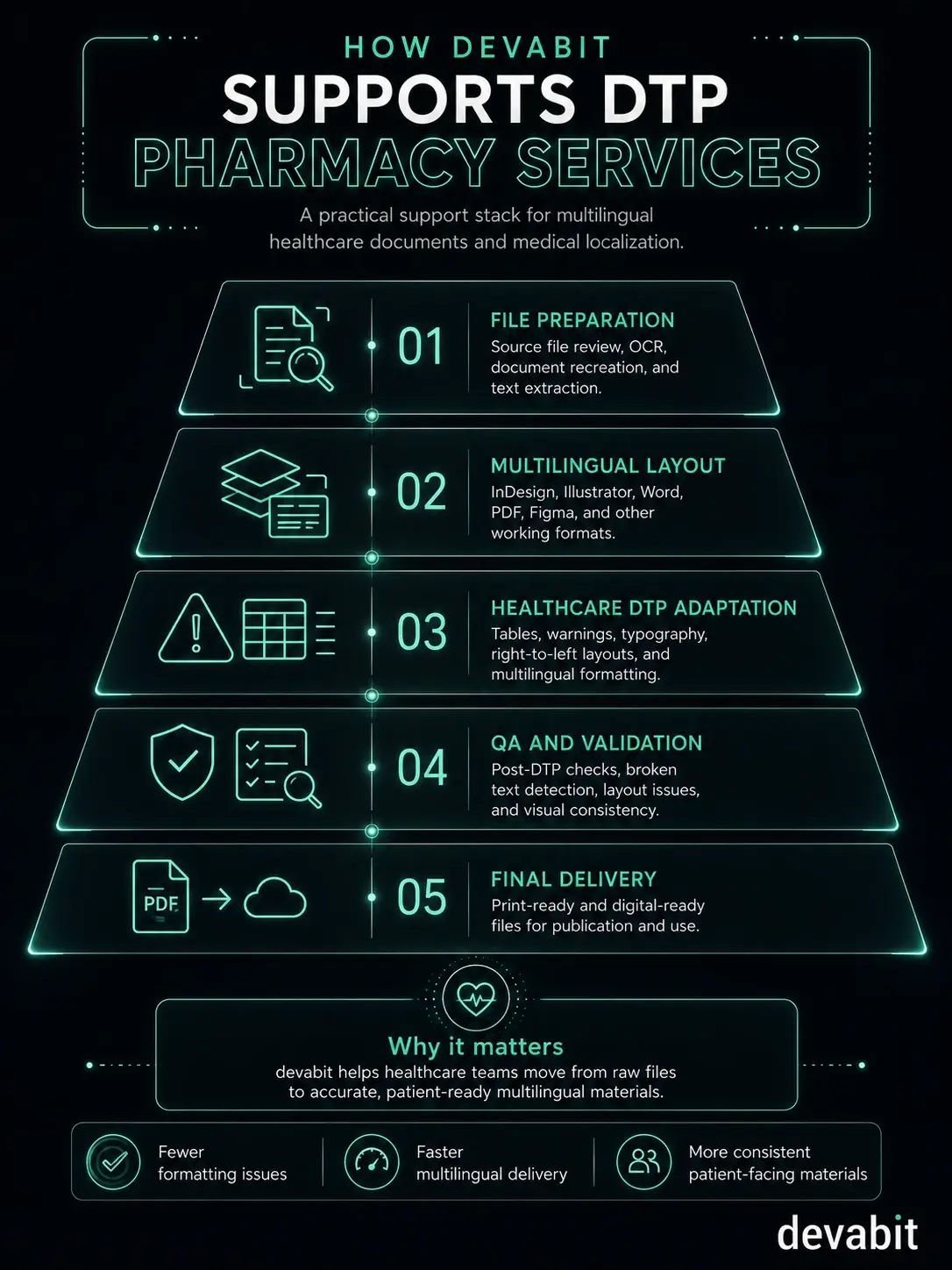
For organizations that handle healthcare translation services, pharmacy translation services, or medical device translation services, this kind of technical support can reduce the burden on internal teams and help prevent layout-related errors that appear after translation. devabit's approach combines human expertise with structured DTP and QC processes. For healthcare organizations, this can be valuable when internal teams lack the time, tools, or specialized layout knowledge to handle multilingual formatting at scale. Instead of treating DTP as a last-minute design task, devabit experts can support it as part of a controlled localization workflow: preparing files before translation, formatting localized content, checking final layouts, implementing feedback, and delivering files that are ready for use. So if you seek prosperous collaboration with a trusted team of DTP pharmacy professionals, you are in the right place.
DTP Pharmacy Services as Part of Safer Multilingual Healthcare
The future of healthcare communication is multilingual, digital, regulated, and patient-centered. That makes DTP pharmacy services more than a production task, but a significant part of how pharmacies and healthcare organizations make information understandable across languages. At devabit, we support this final but critical stage of healthcare localization. Our team can help with multilingual DTP for pharmacy leaflets, patient education materials, healthcare forms, brochures, IFUs, medical device manuals, packaging inserts, and digital assets. We adapt layouts, fix formatting issues, recreate non-editable files, check typography, preserve visual hierarchy, and prepare files for print or digital delivery. Even the most accurate medical translation services can lose value if the final document is hard to read. Reliable DTP pharmacy services protect the last mile of multilingual healthcare communication, and if you want to discuss opportunities, check our expertise firsthand, or find out more about devabit services, Contact Us and request a free quote for your project today.
Recent Publications
Don't miss out! Click here to stay in touch.
Hire DTP Experts

Relevant Articles View all categories
View all categories CONNECT WITH US WE’RE READY
TO TALK OPPORTUNITIES
THANK YOU! WE RECEIVED YOUR MESSAGE.
Sorry
something went wrong