

NCPDP F6 Guide: Healthcare Software Compliance for Pharmacies, Payers & Providers
For more than a decade, NCPDP D.0 has powered the everyday healthcare software compliance that keep prescriptions moving across the US healthcare system. But pharmacy has changed dramatically since D.0 was adopted. Specialty drugs now reach million-dollar price points. Benefit designs are more complex. Coordination of benefits involves more moving parts. And patients, pharmacies, payers, and PBMs all expect faster, cleaner, and more accurate data exchange. That is exactly why the industry is moving to NCPDP F6. For some organizations, the transition will be a manageable upgrade. For others, it will expose years of technical debt hidden inside claims engines, pharmacy platforms, payer sheets, databases, EDI gateways, and partner integrations. And the deadline is closer than it looks. By April 14, 2028, covered entities must be ready to use NCPDP F6 and Batch Standard Version 15 for applicable transactions. In this guide, we break down what NCPDP F6 is, why the industry is moving away from D.0, what will change for pharmacies, payers, PBMs, and healthcare providers, and how organizations can prepare before the transition turns into a last-minute compliance fire drill.

- What Is NCPDP F6?
- Why the Industry Is Moving from D.0 to F6
- Key NCPDP F6 Compliance Dates
- What Will Change for Pharmacies?
- What Will Change for Payers and PBMs?
- What Will Change for Healthcare Providers?
- The Technical Impact: Why F6 Is More Than a Standards Update
- NCPDP F6 Compliance: The Deadlines Are Coming
What Is NCPDP F6?
NCPDP F6 refers to NCPDP Telecommunication Standard Implementation Guide Version F6, the updated standard for electronic retail pharmacy transactions in the United States. It replaces the long-used NCPDP D.0 standard for covered retail pharmacy transactions, including pharmacy claims, eligibility, referral certification and authorization, and coordination of benefits.
The US Department of Health and Human Services adopted F6 through the HIPAA Administrative Simplification rulemaking process. In practical terms, F6 defines how pharmacy transaction data is structured and exchanged between pharmacies, payers, pharmacy benefit managers, switches, software vendors, and other entities involved in prescription drug claims and benefits processing.

And after all, it is one of the most important pharmacy transaction modernization efforts since the industry moved to D.0 more than a decade ago.
Why the US Healthcare Industry Is Moving from D.0 to F6
In short, the current D.0 standard was adopted in 2009 and no longer fully supports today's pharmacy business needs and healthcare software compliance requirements. HHS states that the updated standards are intended to support more robust data exchange, workflow automation, patient safety, coordination of benefits, and expanded financial fields.
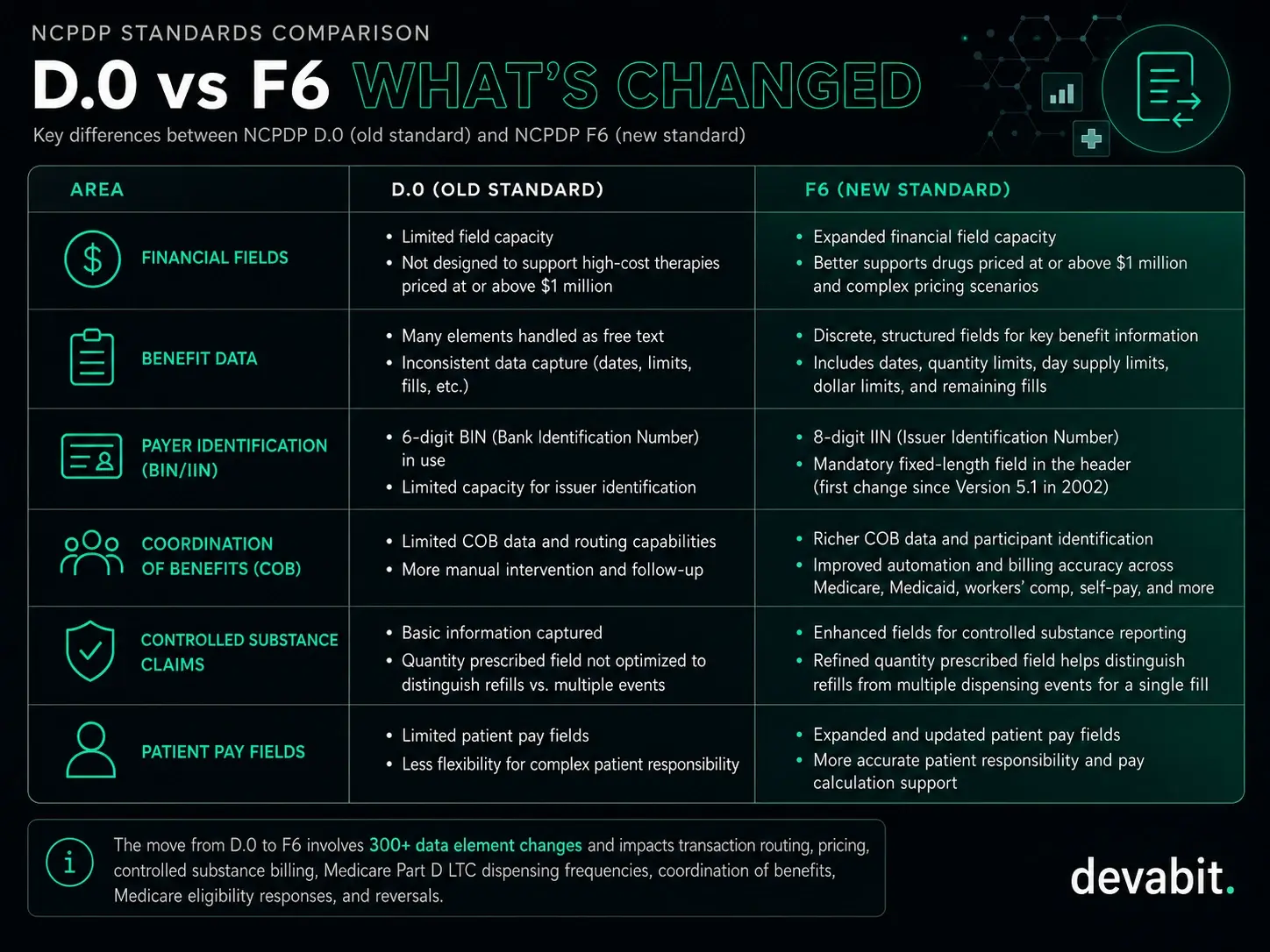
Also, several industry realities made the move necessary. First, specialty and high-cost therapies have sharply changed pharmacy economics. Version F6 expands financial field capacity so transactions can better support drug therapies priced at or above $1 million, something D.0 was not designed to handle well.
Second, F6 improves how plan benefit information can be communicated. HHS notes that F6 supports discrete fields for information that was often handled through free text in D.0, including dates, quantity limits, day supply limits, dollar limits, and remaining fills.
And third, F6 supports richer coordination of benefits and payer-identification data within healthcare software compliance systems, helping reduce manual processes and improve billing accuracy across Medicare, Medicaid, workers' compensation, self-pay, and other payer scenarios.
Key NCPDP F6 Compliance Dates
The December 2024 final rule originally adopted NCPDP F6 and the equivalent NCPDP Batch Standard Version 15. A later 2025 interim final rule updated the timeline. The current federal timeline is:
- Effective Date: April 14, 2025
- Transition Period Begins: August 14, 2027
- Full Compliance Date: April 14, 2028
During the transition period, covered entities may use either D.0/Batch 1.2 or F6/Batch 15, as agreed by trading partners. Beginning April 14, 2028, covered entities must use F6 and Batch 15 for the applicable transactions in their healthcare software compliance solutions.
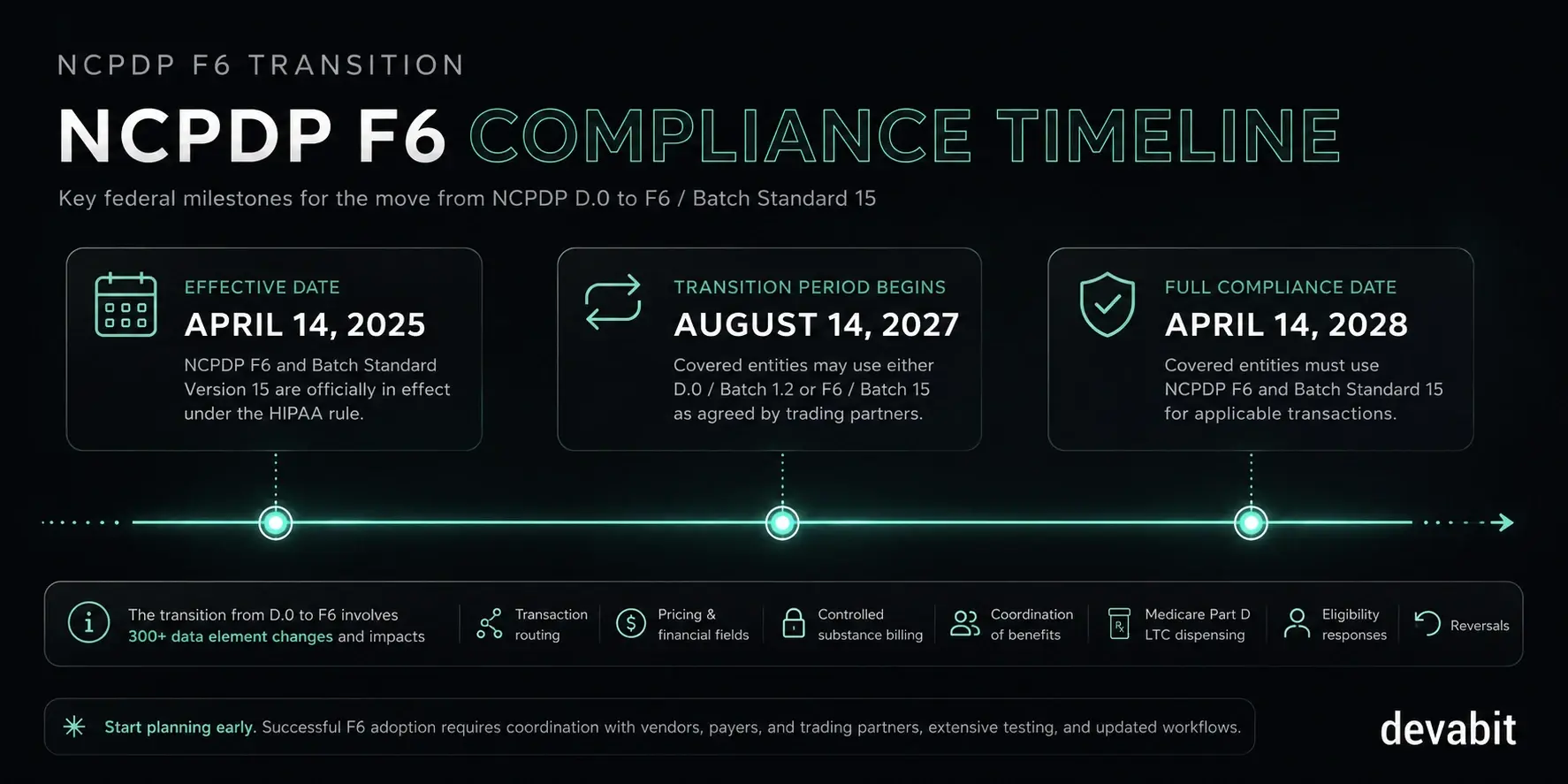
That timeline may look generous, but the work is substantial. HHS cited public comments stating that the move from D.0 to F6 involves more than 300 data element changes and affects transaction routing, pricing, controlled substance billing, Medicare Part D long-term care dispensing frequencies, coordination of benefits, Medicare eligibility responses, and reversals.
And now that we are familiar with the milestones of the upcoming transition, it is time to answer the key questions: what will change for your company? How to prepare for the NCPDP F6 transition? And what pitfall should you be prepared for?
What Will Change for Pharmacies?
For pharmacies, NCPDP F6 will mainly affect the systems and workflows behind everyday prescription transactions. The most visible change will be the need for pharmacy management systems and healthcare software compliance to support the new transaction format, expanded fields, updated payer sheets, and revised claims logic.
Pharmacies will need to validate that their software vendors, switches, and payer/PBM trading partners are ready for dual-version testing and eventual F6-only processing. F6 also improves support for controlled substance claim information. CMS previously highlighted improvements to information attached to controlled substance claims, including refinement of the quantity prescribed field, which helps distinguish refills from multiple dispensing events for a single fill.
Moreover, pharmacies should also expect updates around pricing and patient pay calculations. HHS noted that F6 includes expanded pricing fields and changes to patient pay fields, which creates implementation complexity but also enables more accurate processing of high-cost therapies and financial responsibility.
For devabit, the business impact is clear: pharmacy teams will need training, updated operating procedures, regression testing, and a plan for handling rejections or discrepancies during the transition window.
What Will Change for Payers and PBMs?
For payers and PBMs, F6 is a modernization project across claims adjudication, eligibility, benefit design, pricing, routing, data storage, reporting, and partner connectivity. One of the biggest changes is the move from a 6-digit BIN to an 8-digit Issuer Identification Number field.
HHS explains that F6 includes an 8-digit mandatory fixed-length field to accommodate 8-digit IINs, representing the first change to the NCPDP Telecommunication Standard header section since Version 5.1 was adopted in 2002. Payers and PBMs must also prepare for payer sheet updates, benefit configuration changes, expanded financial fields, and coordination-of-benefits enhancements within their updated healthcare software compliance solutions. The move is particularly meaningful for organizations managing specialty drugs, complex benefit rules, government programs, and multiple downstream vendors.

HHS estimated total industry conversion costs at approximately $384.3 million, including costs for chain pharmacies, independent pharmacies, PBMs, pharmacy management system vendors, and switches. PBMs alone were estimated at $128 million in conversion costs.
What Will Change for Healthcare Providers?
Although F6 is primarily a retail pharmacy transaction standard, healthcare providers are still part of the broader medication ecosystem that is about to be affected by the NCPDP F6. The final rule clarifies that F6 applies to providers that dispense prescription drugs, including retail pharmacies, mail-order pharmacies, doctors' offices, clinics, hospitals, long-term care facilities, and other entities that dispense prescriptions.
For provider organizations with in-house dispensing, ambulatory pharmacy operations, specialty pharmacy programs, hospital outpatient pharmacies, or long-term care dispensing workflows, F6 may affect claims submission, eligibility checks, benefit coordination, prior authorization-related data, and financial communication.
Moreover, providers should also watch adjacent NCPDP standards for their healthcare software compliance. CMS and ONC adopted NCPDP SCRIPT Standard Version 2023011 for e-prescribing, required as of January 1, 2028, along with updated Formulary & Benefit and Real-Time Prescription Benefit standards required in 2027.
The Technical Impact: Why F6 Is More Than a Standards Update
In addition to resolving healthcare software compliance challenges, NCPDP F6 will require deep technical work across healthcare and pharmacy software ecosystems. Affected organizations will need to update database schemas, transaction parsers, claims engines, eligibility modules, benefit configuration tools, pricing logic, reporting pipelines, audit logs, partner APIs, EDI gateways, QA environments, and monitoring systems.

The change is particularly challenging because many systems were built and optimized around D.0 assumptions. Expanded pricing fields, revised patient pay structures, 8-digit IIN routing, new discrete benefit fields, and updated payer sheet requirements can touch both front-end workflows and back-end adjudication logic.
The transition period also creates a dual-processing challenge. Trading partners must be able to support both versions during the transition, and NCPDP recommends that partners support both versions rather than forcing exclusive use of the new standard before the compliance date. That means organizations need more than code changes, but also governance, testing strategy, vendor coordination, and a clear migration roadmap for their freshly-upgraded healthcare software compliance systems.
This often comes with multiple workflow bottlenecks and requires way more resources and effort than your internal teams can handle. And here is how we see the most straightforward guide to effortless NCPDP F6 transition for pharmacies and healthcare providers.
How to Prepare for the NCPDP F6 Transition
Our key takeaway is that the most forward-looking organizations will not wait until 2027. A practical healthcare software compliance readiness plan should begin with a full impact assessment.
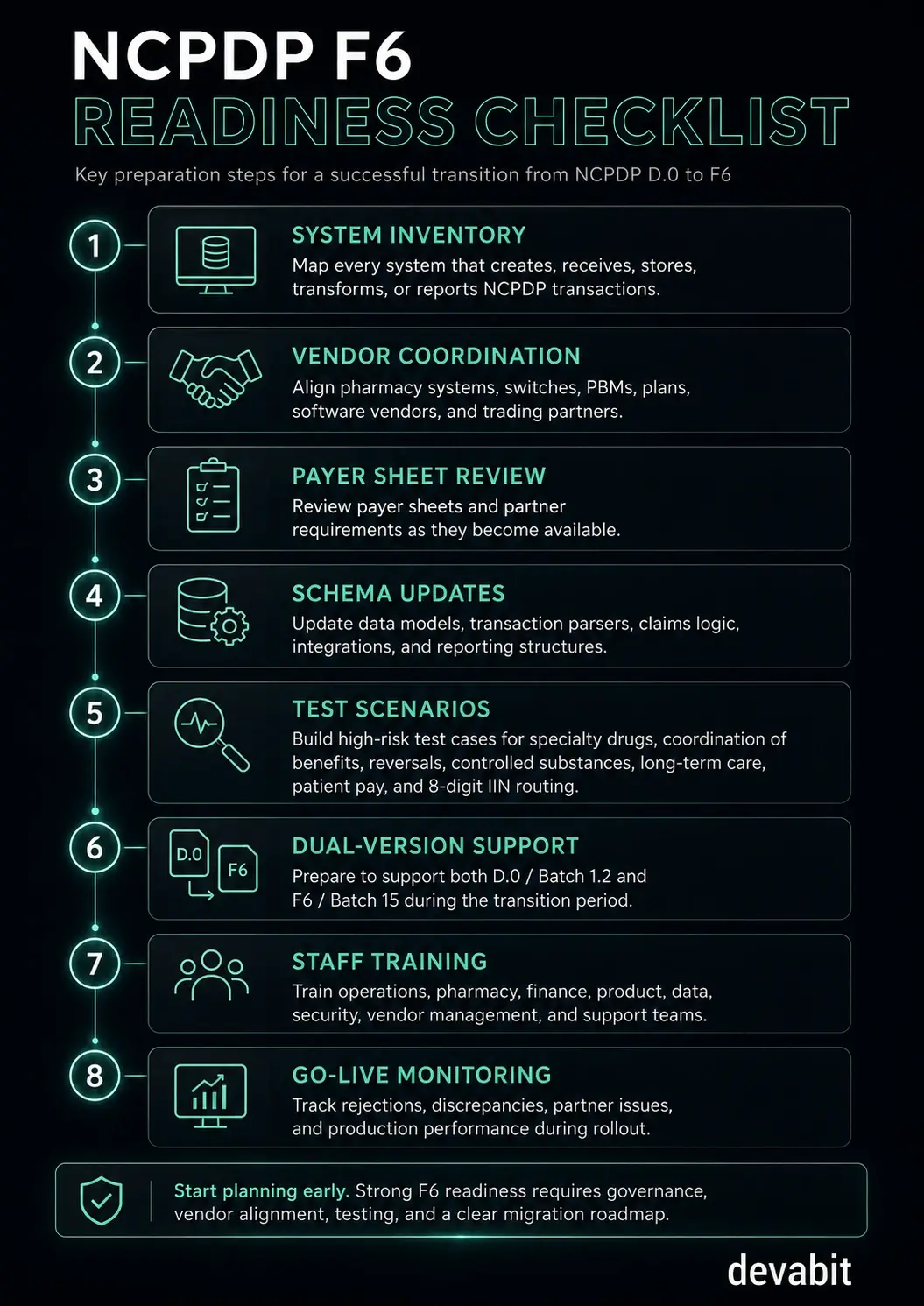
Start by mapping every system that creates, receives, stores, transforms, or reports NCPDP D.0 transactions. Then identify impacted vendors, switches, PBMs, plans, pharmacy systems, claims engines, data warehouses, analytics tools, and downstream reporting processes. Next, review payer sheets and trading partner requirements as they become available. NCPDP's transition guidance includes payer sheet publication, formal and informal testing, remediation, and transition-to-full-use phases before the April 2028 compliance date.
Organizations should also build test scenarios for high-risk use cases:
- high-cost specialty drugs,
- coordination of benefits,
- eligibility responses,
- reversals,
- controlled substances,
- long-term care dispensing,
- patient pay calculations,
- and 8-digit IIN routing.
Finally, assign ownership. F6 requires collaboration among operations, pharmacy network teams, clinical teams, finance, product, data, security, vendor management, and customer support. That is only a quick peek into the extensive process of the NCPDP F6 transition, but if you want to find answers to questions such as:
- What is NCPDP F6, and why should US pharmacies care about it?
- What actually changes after the NCPDP F6 deadline?
- What if you missed the deadline?
- How NOT to lose your license soon?
- What should a healthcare compliance solution include?
- What are the pitfalls and challenges of the NCPDP F6?
- Build in-house or outsource?
- How do you choose a healthcare compliance software provider?
You can find them in our all-in-one guide to the flawless NCPDP F6 transition right below. Together with a healthcare compliance expert, Valery Gurovich, and devabit CTO Oleh Zakharia, we gathered all the best technical insights and only proven NCPDP-related documentation to help our readers access specialized help in plain English.
How devabit Can Help
The NCPDP F6 transition is exactly the kind of healthcare software compliance development challenge where the right engineering partner can reduce risk, accelerate delivery, and protect business continuity. Meanwhile, an incompetent one can make you miss the deadlines and lose the most valuable resource — your time.

Our custom healthcare and pharmacy software development company helps healthcare organizations plan and execute complex software modernization projects, including standards-based interoperability, healthcare software compliance development, EDI and API integrations, claims and billing platforms, data migration, QA automation, and cloud modernization. devabit teams can support your NCPDP F6 transition through:
- Healthcare Software Compliance Development: custom development for pharmacy platforms, payer systems, claims engines, eligibility tools, provider portals, and interoperability solutions.
- NCPDP F6 Readiness and Implementation Support: system impact assessment, architecture review, data model updates, transaction mapping, integration development, and testing support.
- Dedicated Development Teams: experienced engineers, QA specialists, business analysts, DevOps engineers, and healthcare domain experts who work as an extension of your internal team.
- Software Development Outsourcing: flexible delivery capacity for organizations that need to move faster without overloading internal IT teams.
- Testing and Compliance Support: regression testing, integration testing, partner testing, test automation, and production-readiness validation.
- Legacy System Modernization: refactoring, re-platforming, database upgrades, API enablement, and cloud migration for systems that were built around older transaction standards.
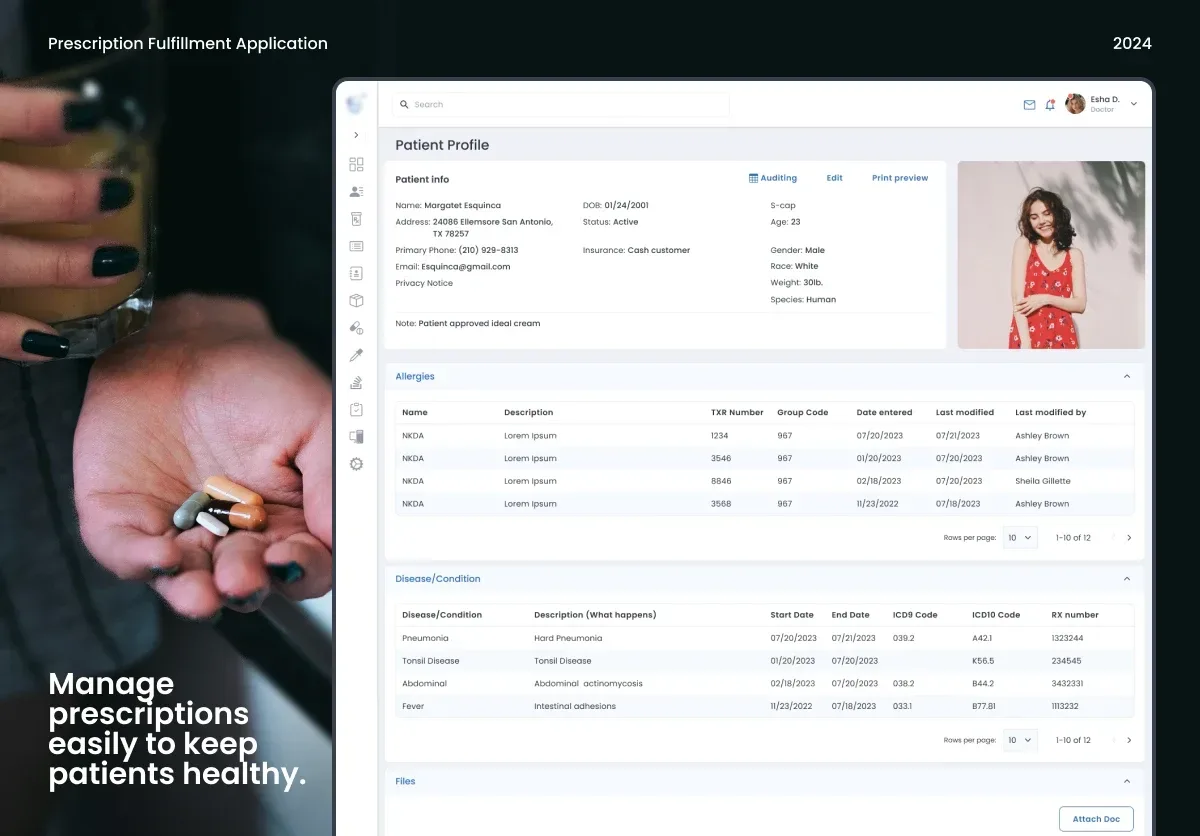
Whether you are a pharmacy technology vendor, payer, PBM, provider organization, or healthcare startup, our team can help turn F6 compliance from a regulatory burden into a modernization opportunity.
NCPDP F6 Compliance: The Deadlines Are Coming
NCPDP F6 will reshape how pharmacy transaction data moves across the whole US healthcare ecosystem. For pharmacies, it means updated systems and workflows. For payers and PBMs, it means modernized adjudication, routing, pricing, and coordination logic. For providers that dispense medications, it means preparing for a more structured, interoperable pharmacy transaction environment. The deadline is April 14, 2028, but the real work starts much earlier. Organizations that begin now will have more time to assess risks, align vendors, test thoroughly, and avoid last-minute disruption. And that is a real opportunity to build cleaner data flows, stronger automation, better patient safety, and more resilient healthcare software compliance. If you seek a trusted healthcare software compliance development partner to help you navigate multiple transition challenges, outsource the most complicated tasks, and deliver expert consulting, Contact Us now to get a free quote on your project.
Recent Publications
Don't miss out! Click here to stay in touch.
Healthcare-Related Content

Relevant Articles View all categories
View all categories CONNECT WITH US WE’RE READY
TO TALK OPPORTUNITIES
THANK YOU! WE RECEIVED YOUR MESSAGE.
Sorry
something went wrong