

Progressive Web App Examples: Key Technologies & How to Build One in 2026
There was a time when building a digital product meant making a hard choice: a website or a mobile app. Websites were easy to access but limited in functionality. Native apps were powerful but expensive, heavy, and often ignored after download. Today, that trade-off no longer has to exist. Progressive web apps (PWAs) quietly changed the rules. They load instantly, work offline, feel like real apps, and do not ask users for commitment upfront. That is why progressive web app examples are no longer an experiment used by a few tech giants, cause they have become a practical solution for businesses that care about performance, reach, and real user behavior. Yet despite their growing adoption, PWAs are still widely misunderstood. Some see them as “just advanced websites.” Others expect them to fully replace native apps in every scenario. The reality sits somewhere in between, and understanding that difference is what makes or breaks a product decision.
In short, today we will explore the following topics:
- What are Progressive Web Apps (PWAs)?
- Progressive Web Apps are web applications that use modern browser technologies to deliver app-like experiences. They work in the browser, load fast, can work offline, send notifications, and can be installed on a device, without requiring an app store download.
- What are the most popular progressive web app examples?
- Well-known progressive web app examples include AliExpress, Starbucks, Twitter Lite, Pinterest, Uber, The Washington Post, and Tinder Web.
- How are PWAs, native apps, and websites different?
- Websites are easy to access but limited in functionality. Native apps offer deep device integration but require installation and higher maintenance. PWAs sit in between: they are discoverable like websites and engaging like native apps, combining the strengths of both with fewer trade-offs.
- Why choose Progressive Web Apps development?
- Progressive Web App development is chosen for faster time to market, broader reach, lower costs, and better performance. PWAs reduce user friction, improve SEO, work across devices from a single codebase, and often deliver higher engagement and conversion rates compared to traditional mobile websites.
Along the way, you will see why many global platforms use PWAs as a growth and performance strategy, how businesses reduce friction and increase engagement with them, and what it actually takes to build a PWA that works, not just in theory, but in real life.

- What Are Progressive Web Apps (PWAs)?
- What Makes PWAs "Progressive"?
- What Makes PWAs Different from Websites and Native Apps?
- How PWAs Blend Web and App Experiences
- 15 Best Progressive Web App Examples That Set the Standards
- 01 / AliExpress — Progressive Web App Examples We All Know
- 02 / Starbucks — Reliable Ordering Experience in Any Network Condition
- 03 / Old Lion Publishing House — Performance-Focused Storefront Design
- 04 / Flipkart Lite — Mobile-First Commerce at Scale
- 05 / Twitter Lite — Heavy Social Media Without the Weight
- 06 / Pinterest — Visual Discovery at High Speed
- 07 / Uber — On-Demand Services Without Barriers
- 08 / Spotify Web Player — Music for Everyone
- 09 / Trivago — Fast Travel Decisions
- 10 / The Washington Post — News Without Delays
- 11 / Forbes — Performance-Driven Publishing
- 12 / Instagram Web — Social at Browser Speed
- 13 / Tinder Web — Match Without Download
- 14 / SoundCloud — Streaming Made Lightweight
- 15 / Alibaba — Global Commerce Optimization
- Progressive Web Apps Development: How devabit Can Help
What Are Progressive Web Apps (PWAs)?
Progressive Web Apps (PWAs) are a modern approach to building web experiences that look, feel, and perform like native mobile apps, without requiring users to download anything from an app store.
Progressive web apps run in the browser like a website, but they provide app-level capabilities such as offline access, push notifications, install-to-home-screen support, fast performance, and a seamless, full-screen interface.
In simple terms, a progressive web app (PWA) combines the reach of the web with the engagement power of mobile apps.
What Makes PWAs "Progressive"?
What makes PWAs "progressive" is that they adapt to the device and browser capabilities available. On a simple browser, a PWA works like a regular website. Meanwhile, on a more advanced device, it unlocks advanced features, like caching content for offline use, loading pages instantly, and syncing data in the background.
This layered enhancement approach makes PWAs reliable, flexible, and highly accessible across platforms and connection speeds.
What Makes PWAs Different from Websites and Native Apps?
Progressive web apps sit in a unique space between traditional websites and native mobile apps, and that is exactly what makes them so powerful and versatile at the same time. While a standard website is accessed through a browser and a native app must be downloaded from an app store, a PWA delivers the strengths of both in a single, unified experience.
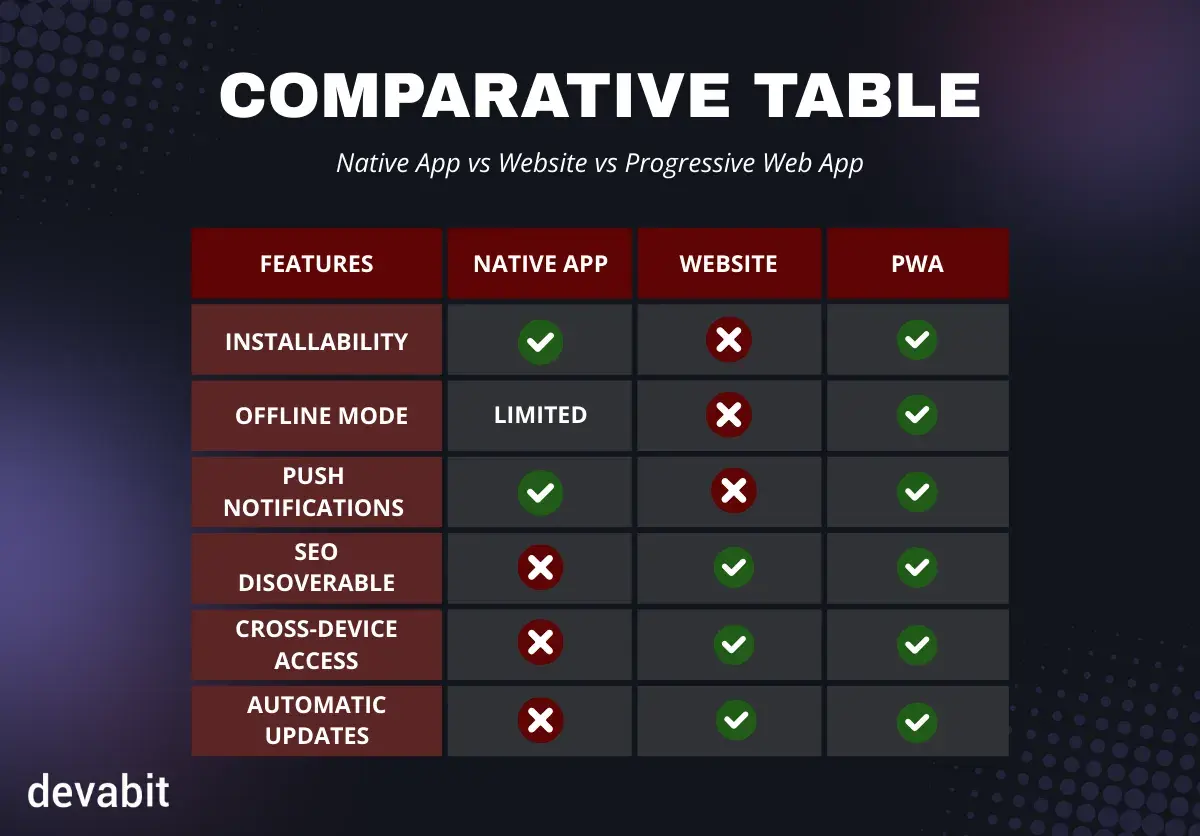
Unlike regular websites, PWAs are designed to be fast, reliable, and interactive even on unstable or offline connections. Thanks to smart caching and background processes, users can open pages instantly, revisit previously viewed content, and continue interacting with the app without constant network access.
Compared to native apps, PWAs remove friction. There is no installation barrier, no app store approval cycle, and no separate builds for iOS, Android, and desktop. A PWA can be added to the home screen with a single tap and opens in a full-screen, app-like interface. Updates are automatic and instant because the experience is delivered via the web, not bundled into a downloadable package.
For businesses, that means lower development and maintenance costs with a broader reach from a single codebase.
How PWAs Blend Web and App Experiences
PWAs also unlock capabilities that websites traditionally lack, such as push notifications, offline operation, background syncing, installability, and device-level integrations, depending on browser support.
At the same time, they avoid many of the limitations of native apps, such as large storage requirements, forced updates, or dependency on app store ecosystems. Ready to face progressive web apps limitations? We will talk about it below.
PWAs blend the openness of the web with the depth of native applications by delivering an interface and interaction model that feels familiar to mobile-app users, gestures, smooth transitions, and immersive layouts, while still running inside a browser environment. Users can access a PWA instantly through a link, yet once installed, it behaves like a standalone application, launching from the home screen, operating in full-screen mode, and storing essential data locally for fast reuse. This hybrid nature is what makes PWAs so effective in real-world scenarios, and what makes them a perfect choice for almost every niche, from e-commerce to beauty and education.
And we think it is the right time to highlight our top 15 progressive web app examples across the most diverse industries right below.
15 Best Progressive Web App Examples That Set the Standards
In this section, we will discover 15 of the best progressive web app examples, from world-renowned solutions to unique projects you may underestimate at first glance.
Progressive web apps have reshaped how online stores deliver performance, accessibility, and user engagement. The following real-world progressive web app examples show how leading brands use PWAs to improve conversions, reduce friction, and create faster, more app-like shopping, learning, or engaging experiences on the web.
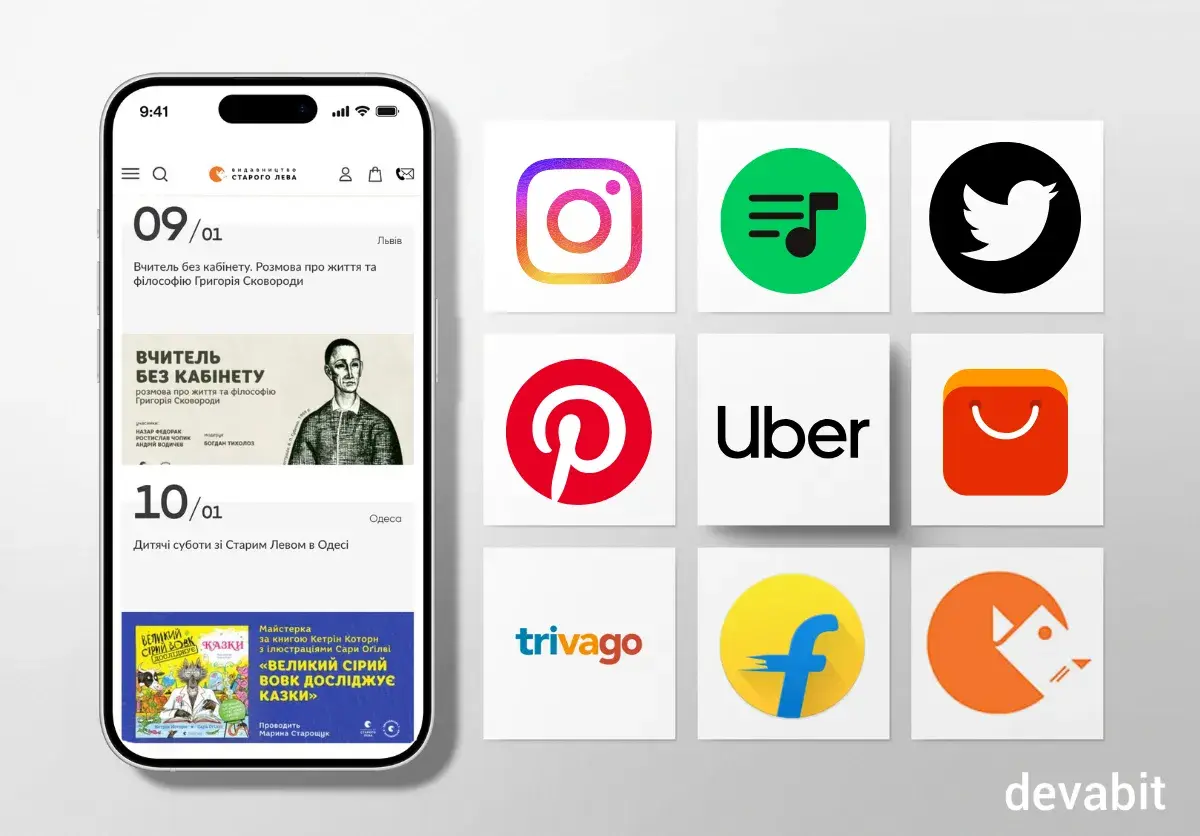
01 / AliExpress — Progressive Web App Examples We All Know
Overview:
AliExpress, one of the leading marketplaces for customers from all over the world, the place where people tend to leave their earnings during late-night shopping, and which was not always as favored. The real game-changer for AliExpress was the decision to adopt a progressive web app to replace its heavy mobile website and reduce friction for users browsing products on low-bandwidth networks and entry-level devices. The result? Mind-blowing numbers of mobile users while still maintaining top desktop traffic.
Key progressive web app features:
- Add-to-Home-Screen installation and app-like UI;
- Instant page transitions with cached resources;
- Offline fallback for previously viewed pages;
- Smooth browsing and interaction across devices.
Business Impact:
- Increased time on site and repeat visits;
- Higher engagement among returning users;
- Notable uplift in mobile conversions.
Why This Example Matters:
AliExpress demonstrates how progressive web apps development helps large marketplaces deliver speed, accessibility, and scalability without relying solely on native apps.
02 / Starbucks — Reliable Ordering Experience in Any Network Condition
Overview:
Only ten years ago, we could barely associate fast-service coffee shops with online experiences or a mobile-first mindset. But everything changed when Starbucks introduced a PWA to provide a consistent ordering experience for users in regions with unstable internet connections and devices with limited storage. Today, it is hard to imagine a busy morning without a quick and effortless drink order.
Key progressive web app features:
- Browsing and customizing orders even when partially offline;
- Local caching for menus and user preferences;
- Lightweight build optimized for low-end phones;
- Seamless transition from offline to online checkout.
Business Impact:
- Faster mobile experience compared to the old web version;
- Broader reach in emerging and mobile-first markets;
- Greater accessibility for on-the-go users.
Why This Example Matters:
Starbucks, as our third nominee in top progressive web app examples, proves that customer journey now begins not with the alluring bakery smell but with an unmistakable online and offline experience.
03 / Old Lion Publishing House — Performance-Focused Storefront Design
Overview:
The timeless devabit e-commerce solution, as one of our top progressive web app examples, custom-built for a renowned publishing brand, focuses on creating a modern, high-performance, mobile-friendly shopping experience with scalability at its core. When initiating a progressive web apps development for the largest Ukrainian publishing house, the devabit team clearly saw the perfect opportunity to combine both the robustness of web shopping platforms and lightning-speed of mobile apps to please the demands of any modern reading fan.
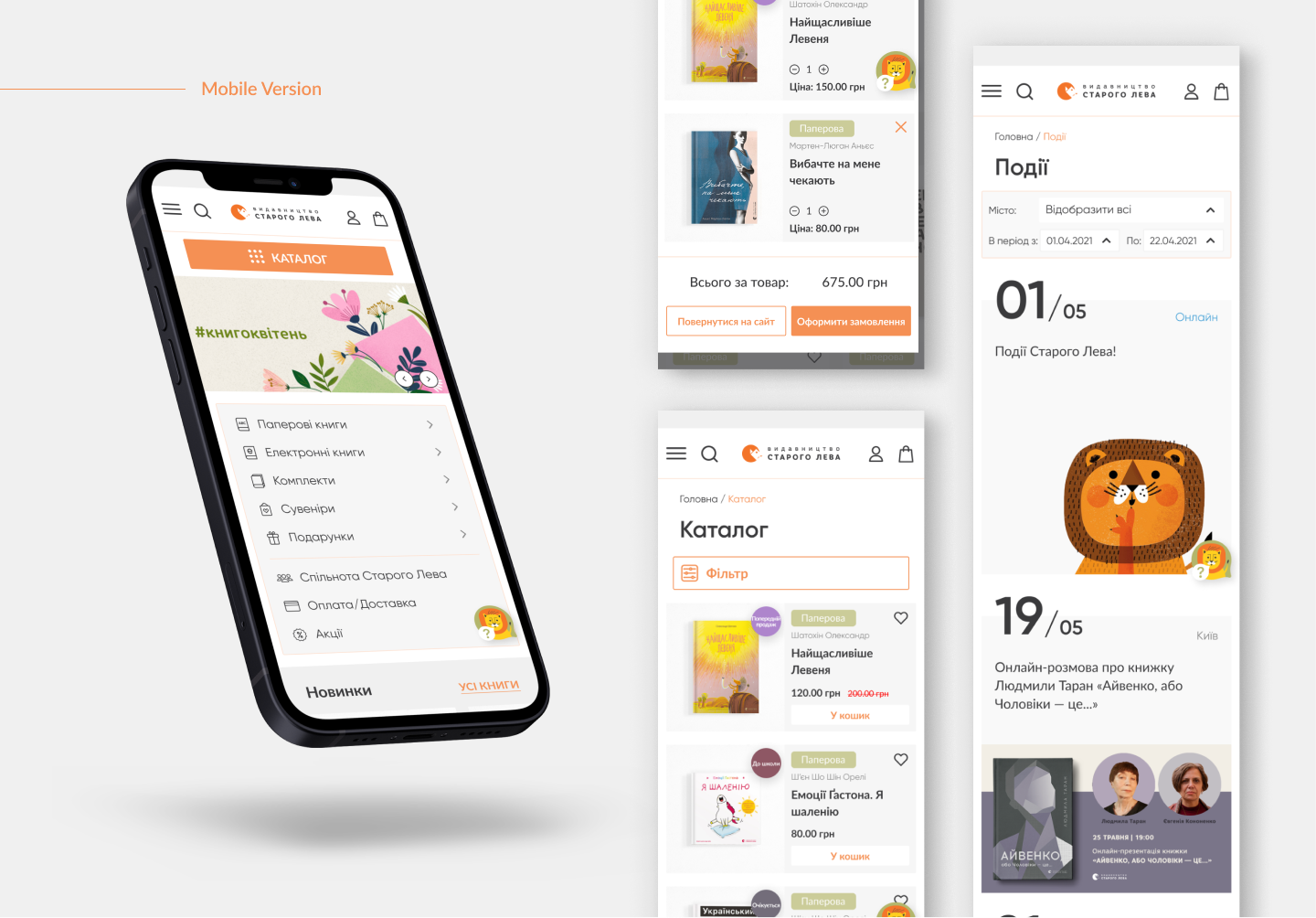
In addition to an unmistakable brand identity, the publishing house received an all-in-one progressive web app solution that satisfies both in-depth bookworms using desktops and quick-pick fans preferring the mobile version.
Key progressive web app features:
- Mobile-first product browsing and navigation;
- Optimized page performance and asset handling;
- Smooth catalog and checkout interaction flow;
- Flexible architecture supporting progressive enhancements.
Business Impact:
- Improved usability across devices;
- Faster customer interactions and reduced friction;
- Future-ready foundation for advanced capabilities.
Why This Example Matters:
When starting a brand-new web project or breathing new life into an existing solution, progressive web apps development is the safest option for reaching the widest audience and delivering top-notch services and products under any conditions, whether in offline mode, with poor connectivity, or across devices.
And in case you want to know how devabit developers built an outstanding progressive web app for the most influential publishing house in Ukraine that still rocks the mobile book shopping seven years after its release, follow the link below to see how we transform ideas into future-proof solutions.
04 / Flipkart Lite — Mobile-First Commerce at Scale
Overview:
Flipkart, the website where you can buy literally everything, and now via mobile too. Flipkart Lite was created to address slow connections, limited device storage, and the reluctance of users to install heavy native apps. Flipkart, among other progressive web app examples, delivers a smooth, app-like shopping experience directly through the browser, making large-scale e-commerce accessible to millions of mobile-first users. By considering the needs of the majority of Flipkart's audience, the company managed to ensure instant shopping access even in low-connectivity environments.
Key progressive web app features:
- Fast loading with aggressive caching strategies;
- Add-to-Home-Screen functionality;
- Offline browsing for product listings;
- Smooth navigation with minimal data usage.
Business Impact:
- Higher re-engagement rates;
- Longer session durations;
- Improved conversion rates on mobile devices.
Why This Example Matters:
Flipkart Lite proves that progressive web app examples can successfully replace native apps in mobile-first markets without sacrificing performance or usability, leading to both maintenance costs reduction and engagement rates increase.

Overview:
The users asked, and Twitter listened. Twitter Lite was initially built to offer a fast, data-efficient alternative to the native app while preserving core social functionality. Twitter Lite, as our next progressive web app example, allows users to scroll, tweet, and interact even on slow networks. This way, this social media platform does not miss a single opportunity to be available to all its users, even in low-connectivity areas and on outdated devices.
Key progressive web app features:
- Offline access to cached timelines;
- Push notifications for real-time engagement;
- Lightweight architecture;
- Installable app-like experience.
Business Impact:
- Lower bounce rates;
- Increased tweets per session;
- Broader reach in low-bandwidth regions.
Why This Example Matters:
Twitter Lite showcases how progressive web app examples can sustain high engagement even for content-heavy platforms without app-store dependency.
06 / Pinterest — Visual Discovery at High Speed
Overview:
A perfect place for quick inspiration, sharing art, ideas, or contributing to the most diverse fandoms. Pinterest introduced a progressive web app to address slow load times and low engagement on the mobile web. The result is a visually rich yet fast experience across desktop and mobile devices. Thanks to ensuring instant loads and a user-first exploring experience, Pinterest now transforms into a competitive social media, and not just a bunch of creative, handmade ideas in one place.
Key progressive web app features:
- Fast image loading with smart caching;
- Smooth scrolling and transitions;
- Offline browsing of saved content;
- Home-screen installation.
Business Impact:
- Significant increase in time spent on site;
- Higher engagement among mobile users;
- Improved retention rates.
Why This Example Matters:
Pinterest, as our top progressive web app example, proves that visually heavy platforms can still deliver speed-first experiences using PWA technologies. And when creating a similar experience for your users, you still doubt whether to choose a robust native application or a lightning-speed website, sometimes you do not need to choose only one.

07 / Uber — On-Demand Services Without Barriers
Overview:
How many times have you been late to an urgent meeting cause your ride-sharing app would not respond? Uber, our next candidate in top progressive web app examples, you will likely find on your device, focuses on instant accessibility, allowing users to request rides directly from the browser, even on low-end devices or unstable networks. And this PWA is not only about delivering top-quality web services but also about delivering you anywhere, anytime, and under any conditions.
Key progressive web app features:
- Ultra-fast initial load;
- Optimized performance for 2G/3G networks;
- Responsive design across devices;
- Installable experience.
Business Impact:
- Expanded global accessibility;
- Reduced user friction;
- Higher task completion rates.
Why This Example Matters:
In this case, progressive web examples demonstrate how to excel in time-sensitive, transactional use cases. And despite an unlimited range of options in the app store, people still turn to Uber due to its high responsiveness, passenger-centric approach, and lightweight nature.
08 / Spotify Web Player — Music for Everyone
Overview:
Hope you enjoyed your Spotify Wrapped 2025! Cause we definitely did. With over 713 million users monthly, Spotify’s PWA allows users to stream music directly from the browser with a consistent experience across desktop and mobile. The number of Spotify's active users has almost doubled over the past few years, and PWA adoption plays a key role in that rapid shift, showcasing how a small upgrade makes a huge impact.
Key progressive web app features:
- Offline caching for playback continuity;
- Responsive, app-like interface;
- Seamless cross-device usage.
Business Impact:
- Increased web-based listening sessions;
- Lower dependency on native apps;
- Improved accessibility.
Why This Example Matters:
Spotify, as our eighth in top progressive web app examples, shows how streaming platforms can support rich media experiences beyond the simplest content consumption.

09 / Trivago — Fast Travel Decisions
Overview:
An ideal solution for planning your next trip, and now even more accessible. Trivago used a progressive web apps development to help users search and compare hotel prices quickly, regardless of network quality. The result? A lightning-fast, app-like experience that loads in seconds, even on slow or unstable connections. With smart caching and optimized performance, users can browse hotel options, compare prices, and revisit recent searches without waiting for pages to reload.
Key progressive web app features:
- Instant search results with caching;
- Offline access to recent searches;
- Installable interface.
Business Impact:
- Higher booking engagement;
- Faster decision-making;
- Improved mobile performance.
Why This Example Matters:
Travel platforms benefit enormously from speed and reliability, areas where progressive web app examples excel the most. And that is the most straightforward way to reach your target audience, which avoids installing a native application for a short-term holiday.
10 / The Washington Post — News Without Delays
Overview:
Founded in 1877, the Washington Post turned to progressive web apps development to deliver instant news updates and offline reading capabilities. One of the oldest yet most innovative newspapers is not ready to miss the chance to appeal to the demands of modern readers. Moreover, The Washington Post is known for also being one of the fastest-loading news sources on the web.
Key progressive web app features:
- Offline article access;
- Push notifications for breaking news;
- Fast page loads.
Business Impact:
- Increased repeat visits;
- Higher content consumption;
- Stronger reader retention.
Why This Example Matters:
In case you thought newspapers were left in the past, these progressive web app examples serve to prove you wrong every day.
11 / Forbes — Performance-Driven Publishing
Overview:
Who is not dreaming of being #1 on the Forbes list? And who else could know better how to be the first in web performance? Forbes implemented a progressive web apps development to combat slow mobile experiences and declining engagement. As a result, Forbes transformed its mobile and desktop web experience into a fast, reliable, and highly engaging platform for any of its readers.
Key progressive web app features:
- Instant loading;
- Offline reading access;
- SEO-friendly architecture.
Business Impact:
- Lower bounce rates;
- Higher mobile session duration;
- Improved ad performance.
Why This Example Matters:
For content-driven businesses, progressive web apps development is the real game-changer. When you seek to access as much audience as possible, it is not enough to only offer exclusive services or products, but also provide an unmistakable access for all kind of users. And that is how Forbes remains its top positions among other web media.
Overview:
Probably, the most popular social media for sharing our brightest moments with followers since 2010. And today, Instagram’s web progressive web app brings core social features, like browsing feeds, viewing stories, direct messaging, and notifications, directly into the browser, removing the need for a native app in many everyday use cases. Designed to feel familiar and responsive, the web experience closely mirrors the mobile app while remaining lightweight and instantly accessible.
Key progressive web app features:
- Push notifications to re-engage users in real time;
- Responsive UI optimized for both desktop and mobile screens;
- Installable experience with full-screen, app-like behavior.
Business Impact:
- Expanded reach beyond users willing to install native apps;
- Higher engagement on desktop and mobile web platforms;
- Increased accessibility in regions with limited device storage.
Why This Example Matters:
Progressive web app examples demonstrate that you can easily support complex, interaction-heavy social platforms while maintaining performance and usability, all thanks to PWA development. And while we tend to think that everyone has a social media native app installed, hundreds of thousands of users still choose PWA every day. Do you really want to lose all that traffic?
13 / Tinder Web — Match Without Download
Overview:
Tinder knows everything about a perfect match. That is why it became one of our top progressive web app examples. Tinder’s PWA allows users to swipe, match, and chat directly from the browser, replicating the core native app experience without requiring a download. This instant accessibility significantly lowers the barrier to entry, encouraging spontaneous use and quick engagement, especially among first-time or casual users.
Key progressive web app features:
- Gesture-based interactions adapted for web;
- Push notifications for matches and messages;
- Responsive design optimized for mobile and desktop.
Business Impact:
- Increased engagement from casual and first-time users;
- Broader user acquisition through instant access;
- Higher conversion from visitors to active users.
Why This Example Matters:
Tinder demonstrates that progressive web apps are capable of supporting highly interactive, gesture-driven user experiences traditionally associated with native apps. Swiping, real-time messaging, and instant notifications work smoothly within the browser, lowering the psychological and technical barrier to entry. This makes Tinder Web our prime progressive web app example.

14 / SoundCloud — Streaming Made Lightweight
Overview:
Another streaming platform that overcame the boundaries of native app access only. SoundCloud’s progressive web app offers music streaming and discovery directly in the browser, enabling users to listen, explore, and interact with audio content without installing a heavy native app.
Key progressive web app features:
- Offline playback for cached tracks;
- Fast loading and smooth playback;
- Cross-device support for seamless listening.
Business Impact:
- Higher listening sessions on web platforms;
- Improved accessibility across devices;
- Reduced friction for new and returning users.
Why This Example Matters:
SoundCloud highlights how progressive web apps development can successfully enable you to deliver rich media experiences without the overhead of native app installation. Audio streaming, discovery, and interaction remain smooth and reliable even on limited networks or devices with constrained storage. This example is especially valuable for content platforms seeking to balance performance with depth.
15 / Alibaba — Global Commerce Optimization
Overview:
Alibaba operates at an extraordinary scale, serving millions of users across continents, languages, devices, and network conditions. To maintain consistent performance and accessibility worldwide, Alibaba leverages progressive web app technologies as a strategic layer of its digital ecosystem. The goal is not just to sell products faster, but to ensure that every user, regardless of geography or connectivity, receives a reliable, frictionless shopping experience.
Key progressive web app features:
- Offline browsing of previously viewed product listings;
- Smart caching strategies that prioritize critical content and reduce repeated network requests;
- Installable, app-like UI that launches from the home screen and runs in a distraction-free, full-screen mode.
Business Impact:
- Higher user engagement across both developed and emerging markets;
- Improved mobile conversion rates driven by faster load times and smoother navigation;
- Significantly better performance and usability in low-bandwidth and high-latency regions.
Why This Example Matters:
Our last nominee in top progressive web app examples demonstrates that PWAs are not just a performance enhancement, but a perfect global scalability strategy. When serving an audience as diverse as Alibaba’s, consistency and accessibility become competitive advantages. This example reinforces a critical insight: large international marketplaces thrive with PWAs because PWAs adapt to users, not the other way around.

Progressive Web Apps Development: How devabit Can Help
We hope you have gained just enough inspiration from our top progressive web app examples so that we can start talking about progressive web app development, and why YOU need it.
Progressive web app development has moved far beyond experimentation. Today, it is a strategic product decision for companies that value speed, reach, and measurable results. At devabit, as a custom web development company, we help businesses transform PWAs into high-performing digital products that feel app-native, scale effortlessly, and convert users, without unnecessary technical overhead.
Our approach is simple: we focus on what drives real business outcomes, not just what looks good on paper. Among our top progressive web app development services are:
Web Development Consulting for validating any of your ideas, helping you overcome the hesitation barrier, clarifying our pricing options, and estimating the realistic development timelines.
Web Developers for Hire to help you extend your existing teams for short- and long-term projects, or to equip a dream team of dedicated experts from scratch. Top-notch developers, UI/UX designers, testers, project managers, and security experts, all at your service at a pleasant price.
Custom Web Development to help you build outstanding solutions from scratch that meet your unique needs, project requirements, and budget opportunities. Only proven tech stacks, top-notch developers, and trusted approaches, seasoned with over a decade of experience and success stories.
Why Choose Progressive Web Apps Development?
Progressive web apps bring together the best of websites and native applications, while avoiding many of their limitations. When built correctly, PWAs become a competitive advantage rather than just a technical alternative.
Key advantages of PWA development include:
- Instant access without app-store friction. Users open your product via a link and install it only when they see value;
- One solution across devicesб mobile, desktop, and tablet from a single codebase. If you seek to cut operational time and costs, progressive web app development is a perfect solution;
- Fast load times and offline functionality, even on unstable or slow networks;
- SEO-friendly by default, unlike native applications hidden from search engines;
- Lower development and maintenance costs compared to building and supporting multiple native apps;
- Higher engagement and conversion rates, driven by performance-first UX and reduced friction.
For many of our clients, a PWA becomes the shortest path from idea to market, and from first visit to meaningful user action.

Key Progressive Web App Technologies We Use
At devabit, we build progressive web apps using only reliable, proven technologies chosen to match your product goals, audience, and growth plans. Core PWA technologies we implement include:
- Service Workers for offline access, intelligent caching, and background synchronization;
- Web App Manifest to enable installability and native-like behavior;
- HTTPS-first architecture to ensure security and unlock advanced browser capabilities;
- Cache API and IndexedDB for stable local data storage;
- Push & Notifications APIs to re-engage users at the right moment;
- Frontend: React, Next.js, Vue, TypeScript;
- Backend: Node.js, NestJS, REST or GraphQL APIs;
- Infrastructure: Cloud-based hosting, CI/CD pipelines, scalable environments;
- Performance & SEO: Lighthouse optimization, Core Web Vitals, accessibility-first development.
These technologies and stack work together to deliver progressive web apps that feel fast, reliable, and “installed”, even when they live on the web.
Progressive Web Apps Limitations and Challenges
We practice honest engineering. Progressive web apps development is powerful, but they is not universal, and pretending otherwise leads to poor decisions. Common PWA challenges include:
- Platform inconsistencies (especially iOS feature limitations);
- Restricted access to certain hardware or OS-level features;
- Complexity around caching strategies and updates;
- User perception of what a “real app” should be.
At devabit, we mitigate these risks by designing hybrid architectures when native features are essential, implementing safe, predictable caching patterns, and creating clear install and onboarding.
PWA or Native App: What Should You Choose?
Here is our clear pro answer that will help you understand if progressibe web apps development is exactly what you seek. A progressive web app is usually the right choice if you need:
- Maximum reach and fast market entry;
- Strong SEO and discoverability;
- Lower costs and faster iterations content-, commerce-, or productivity-driven experiences;
A native app makes sense if your product:
- Requires deep OS or hardware integration;
- Depends on advanced sensors or system-level features;
- Relies heavily on app-store-centric distribution.
In most cases, the smartest strategy is starting with a PWA and extending to native only when the product truly requires it. And in case you still hesiate, got some questions left, or simply want to receive a free quote on your project, devabit is at your service!

Our top progressive web app examples have proven that modern digital products do not have to choose between reach and functionality. They combine the accessibility of the web with many of the features users expect from native apps, like fast loading, offline access, installability, and consistent performance across devices.
The conclusion is straightforward: progressive web apps are not a replacement for every native app, but they are often the most practical and efficient starting point. What matters most is not the technology itself, but how well it fits your product goals, audience, and long-term plans. Choosing between a PWA and a native app requires technical understanding, but also strategic thinking, especially when performance, scalability, and cost efficiency are involved. This is where devabit can support you. We help teams evaluate whether a progressive web apps development is the right choice, design solutions that match real business needs, and build products that are reliable, maintainable, and ready to grow. And if you are considering a progressive web app or want an informed second opinion on your product approach, we are always open to the conversation here.
Recent Publications
Don't miss out! Click here to stay in touch.
More of Web Development

Relevant Articles View all categories
View all categories CONNECT WITH US WE’RE READY
TO TALK OPPORTUNITIES
THANK YOU! WE RECEIVED YOUR MESSAGE.
Sorry
something went wrong