

Edge AI Software & Smart Mobility: Revealing the Connection
Only a few years ago, AI in vehicles meant sending camera footage to the cloud, waiting for an answer, and hoping the network would not drop at the worst possible moment. Today, that same intelligence no longer phones home. Instead, it lives directly in the car, on the roadside sensor, or inside the fleet robotaxi, without the urge for internet connection at all. This shift from cloud-centric to Edge AI Software is probably the most critical transformation in the automotive and smart mobility industry since the arrival of electronic fuel injection. We are witnessing the rapid spread of Edge AI across the entire smart mobility stack. From fully autonomous robotaxis and delivery bots to intelligent traffic lights and highway infrastructure. In this article, we will explore exactly why Edge AI Software is spreading so fast, what bespoke advantages it unlocks for vehicle users, and which real-world capabilities are already moving from prototypes to production fleets today.
In short, today we will explore the following topics:
- Edge AI is the practice of running artificial intelligence models directly on the device (the car, roadside unit, or robotaxi) rather than relying on the cloud, enabling real-time decisions with minimal latency and zero dependency on constant internet connectivity.
- Smart Mobility is the next generation of transportation that combines connectivity, automation, electrification, and shared services to create safer, cleaner, more efficient, and more accessible movement of people and goods.
- How can Edge AI Software contribute to vehicle safety? By processing sensor data via cameras, radar, LiDAR, and ultrasonics, locally and instantly, Edge AI Software enables instant reactions in critical situations, such as automatic emergency braking, pedestrian/cyclist detection, blind-spot intervention, drowsiness monitoring, and evasive maneuvers.
- Multimodal Transportation (MaaS) means a single application combining walking, e-scooters, bikes, ride-hailing, buses, metro, trains, and ferries into a single seamless journey.
- The global smart mobility market was valued at approximately USD 53.18 billion in 2024 and is projected to reach USD 180.39 billion in 2033, demonstrating a shocking CAGR of 15%.
- The key advantages of Edge AI Software implementation are:
- Ultra-Low Latency;
- High Reliability in All Network Conditions;
- Significantly Enhanced Safety;
- Reduced Energy Consumption;
- Stronger Data Privacy.
- North America holds the largest regional share at 38.03% of the global market in 2025, fueled by advanced infrastructure and tech adoption.
- Thanks to the Edge AI Software implementation, and "Vision Zero" road safety strategy, Helsinki reports that zero-fatality streak has now extended to over 16 months (from July 2024), with no new deaths reported in the intervening period.
Want to find out how? Stay with us!
- What Exactly Is Edge AI in Simple Terms? Edge AI Explained
- What Is Smart Mobility?
- Smart Mobility Industry in Numbers
- What Are Real-World Examples of Edge AI Software in Smart Mobility?
- What Are the Advantages of Using Edge AI Software in Vehicles?
- How Devabit Can Help
- Edge AI Software in Smart Mobility: Crossing the Finishing Line
What Exactly Is Edge AI in Simple Terms?
Simply stated, Edge AI (Artificial Intelligence) means running AI software directly on the device where the data is created instead of sending that data to far-away cloud servers for processing.
In other words:
The Edge stands for the local device, like a camera, phone, vehicle, or robot.
And the AI stands for the smart system analyzing the input data in real time, while processing, analyzing it, and making decisions at the same time, without the urge for cloud infrastructure.
That is why Edge AI is literally on the edge. While the cloud system is the owner of the huge house, Edge AI is the most intelligent assistant that can take actions on its own, eliminating the need to go deep in the house and look for a landlord. It is way more independent and autonomous than you may have thought.

How Does Edge AI Work?
Speaking tech, data is generated locally from sensors such as cameras, LiDAR (Light Detection and Ranging), radars, IMUs (Inertial Measurement Units), microphones, temperature sensors, or networked IoT (Internet of Things) modules.
AI models run on edge hardware using:
- Embedded GPUs (Graphics Processing Units);
- NPUs (Neural Processing Units), TPUs (Tensor Processing Units);
- SoCs (System-on-Chips) with integrated AI accelerators;
- DSPs (Digital Signal Processors);
- Dedicated edge processors, e.g., NVIDIA Jetson, Qualcomm Snapdragon, Tesla FSD computer, Mobileye EyeQ;
The Edge AI model performs real-time processing via:
- Object detection and tracking; Sensor fusion;
- Classification;
- Prediction;
- Control Decisions with deterministic low-latency constraints.
Over and above that, Edge AI Software requires minimal or zero reliance on the cloud ecosystem. Only metadata, compressed features, or aggregated analytics may be transmitted upstream for:
- AI Model Updates;
- Fleet Learning;
- Long-Term Storage;
- Centralized Optimization.
Threat detection! Too many technical terms per paragraph. It seems like we need to take action immediately! Luckily, we have the perfect ready-to-go solution for such cases. Understanding of complex AI technologies may take a while (or not just a while). That is why we have prepared an explanatory guide to Edge AI in automotive intelligence in plain English for those who seek straightforward answers to tricky questions. Follow the link to find Edge AI Software explained in simple words, the top five Edge AI trends revealed, and an industry overview presented.
What Is Smart Mobility?
Let's not forget what we have all gathered here for. And before moving straight to the point of Edge AI in smart mobility, let's put all the dots above the "i"s. What is smart mobility?
Smart mobility refers to a technology-driven approach to transportation that focuses on making the movement of people and goods safer, faster, cleaner, more efficient, and more connected. It combines digital technologies, intelligent infrastructure, advanced vehicles, and data-driven systems into one seamless mobility ecosystem.
In simple terms, smart mobility is the transformation of traditional transportation using connectivity, AI, automation, electrification, and real-time data.
What Are the Key Smart Mobility Sectors?
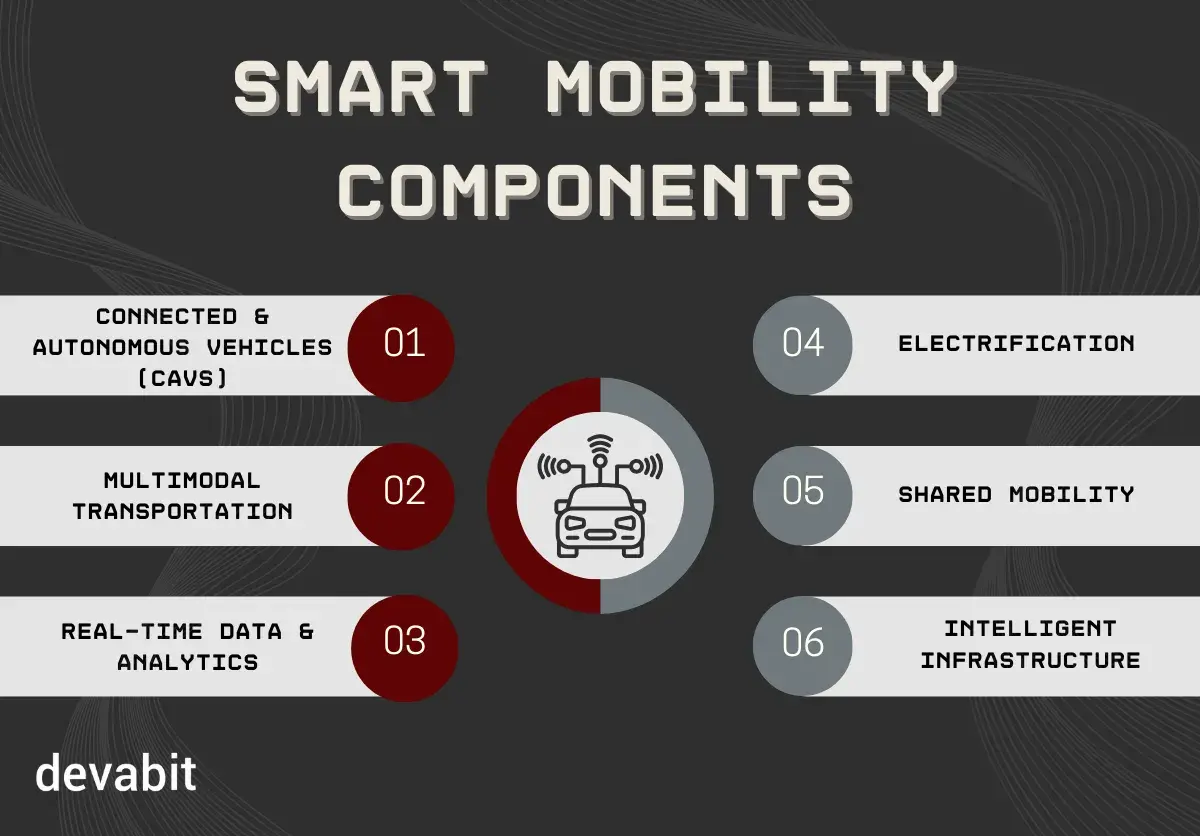
01 / Connected & Autonomous Vehicles (CAVs)
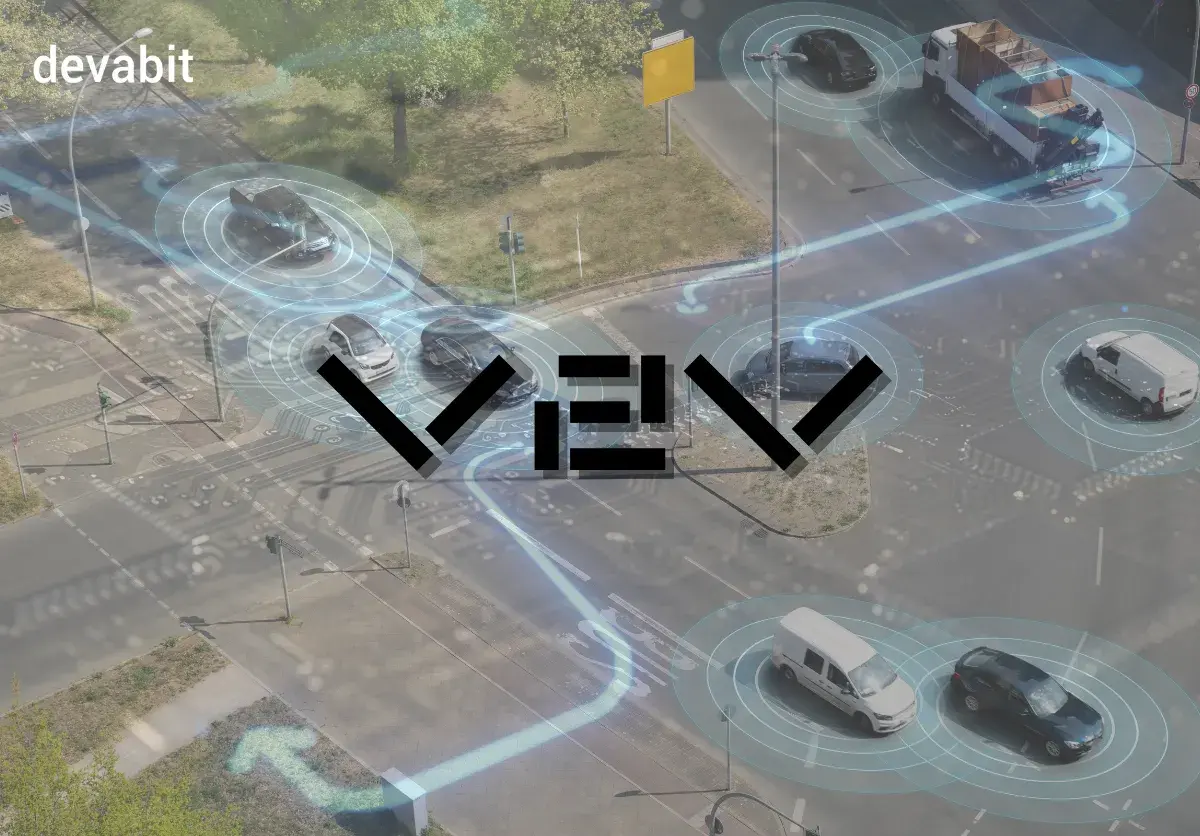
Simply put, CAVs are about fully or partially self-driving vehicles that communicate with each other via V2V (Vehicle to Vehicle), V2I (Vehicle to Infrastructure) technologies, pedestrians, and networks. And use cases include split-second decisions in complex urban environments, handling edge cases like children chasing a ball, construction zones, or emergency vehicles in sight.
What is the role of Edge AI in it? — Edge AI Software runs perception, like object detection, tracking, semantic segmentation, prediction, and planning directly on the vehicle with less than 50 ms latency. Talking about Edge AI software capabilities, it enables emergency braking, lane changes, and intersection handling even with zero connectivity.
And in case V2V (Vehicle to Vehicle) technology still remains a mystery for you, we have just the ideal solution for such a case. devabit has gathered an all-in-one guide to the use of artificial intelligence in the automotive industry in plain English. Follow the link below to reveal the pitfalls and benefits of AI-driven vehicles not of the future, but the very today.
02 / Multimodal Transportation
Multimodal Transportation (MaaS) means a single application combining walking, e-scooters, bikes, ride-hailing, buses, metro, trains, and ferries into a single seamless journey. Some of the well-known real-world examples include Citymapper, Uber, public transit integrations, or Whim in Helsinki.
What is the role of Edge AI in it? — Edge AI Software predicts the best route or vehicle combination in real time, detects when you have possibly boarded the wrong bus using motion and vision, identifies free docking spots via onboard cameras, and keeps routing functional offline.
03 / Real-Time Data & Analytics
Hundreds of data terabytes are generated daily from cameras, vehicle probes, phones, and IoT sensors. And Edge AI Software uses it for congestion management, incident detection, predictive routing, and dynamic road analysis. The Edge AI Software profit range is literally endless, beginning with minimizing road accident rates and maximizing driver experiences.
What is the role of Edge AI in it? — Traffic cameras and roadside units filter 99% of raw data on-site, sending only events, like accidents, debris, or wrong-way drivers, to the cloud. Enables instant reactions, such as flashing signs, speed limit changes, without waiting for central systems.
But traffic optimization is only one example of how on-device intelligence creates real value. The same principles behind Edge AI are local inference, fast decision-making, and selective data transfer that are already being applied across the entire automotive ecosystem.
From driver assistance and autonomous functions to predictive maintenance, in-cabin intelligence, and manufacturing quality control, machine learning is redefining how vehicles are designed, operated, and serviced. These use cases go far beyond theory, showing how ML models work in production environments and deliver measurable impact. To see concrete, real-world automotive machine learning examples and understand how they are implemented end to end, explore our in-depth article here:
04 / Electrification
No secret that Tesla has made a literal revolution in the driver's vision of a perfect car on the road. And the transition from ICE vehicles to battery-electric (BEV) and fuel-cell electric vehicles (FCEV), along with supporting charging infrastructure, is one more vital sector of smart mobility contributing to not only environmental consciousness but also transportation approaches.
What is the role of Edge AI in it? — In case with electrification, Edge AI Software serves inside the battery pack for ultra-precise SoC/SoH estimation and thermal management, inside chargers for load balancing and fault prediction, and inside the vehicle for hyper-accurate range forecasting using driving style and micro-weather.
An old, well-known tale. Yes, we are talking about ride-hailing (Uber, Bolt), car-sharing (ShareNow, Zipcar), scooter/bike-sharing (Lime, Tier, Voi), and microtransit (Via, BerlKönig). And Edge AI Software would never miss the opportunity to contribute to those.
What is the role of Edge AI in it? — With the help of the Edge AI Software, shared vehicles detect crashes, phone distraction, or unauthorized drivers in less than a second, scan for damage at trip end, trigger anti-theft immobilization, and run lightweight demand forecasting on the vehicle itself during network outages.
06 / Intelligent Infrastructure
And our cherry on top of the cake. Smart roads, traffic lights, variable message signs, tunnels, bridges, and parking garages that actively manage flow and safety. All with the help of the Edge AI Software working in a symbiotic system with intelligent infrastructure.
What is the role of Edge AI in it? — Intersection controllers optimize signals every cycle using local camera data, while roadside units broadcast warnings in less than 100 ms, and bridges monitor structural health 24/7 and alert instantly if anomalies appear, all via Edge AI Software.
Smart Mobility Industry in Numbers
And right before we dive deep into the Edge AI Software in smart mobility spread, let's see what exactly has led to this unique and prosperous alliance. What is smart mobility like today?
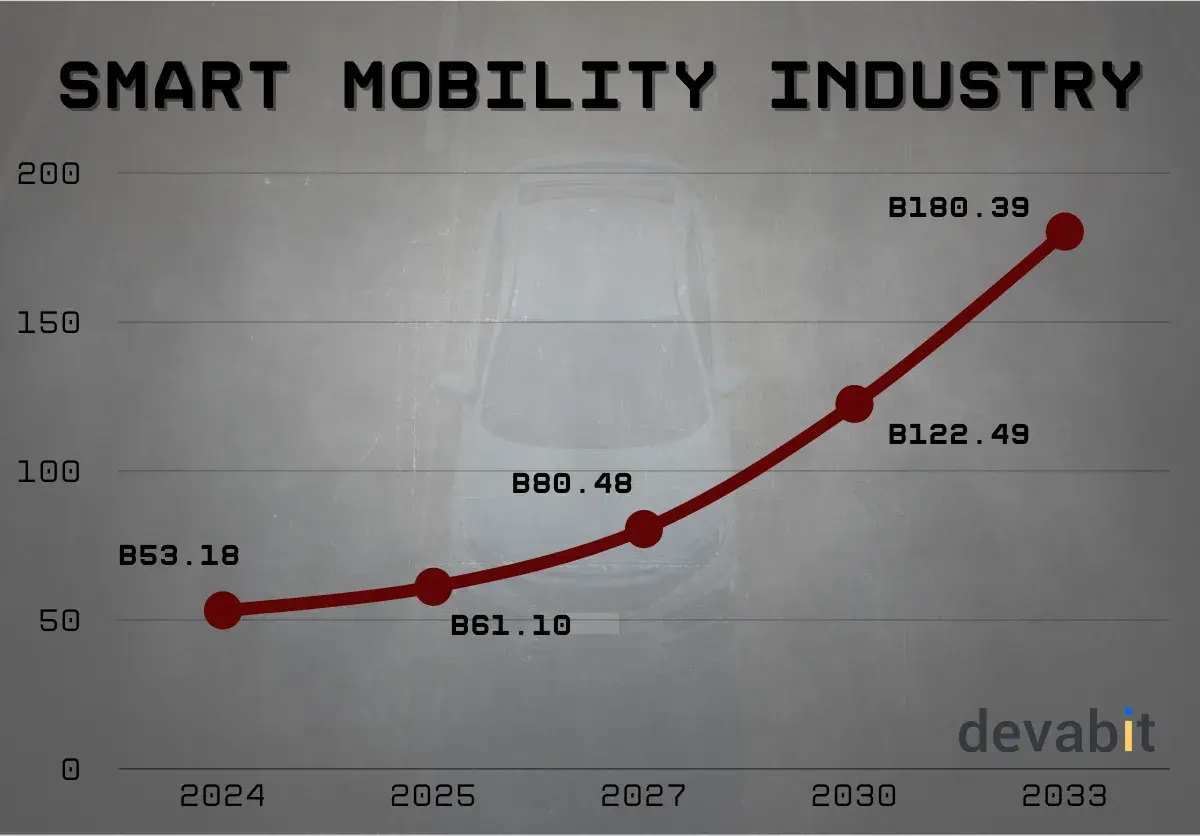
- The global smart mobility market was valued at approximately USD 53.18 billion in 2024 and is projected to reach USD 180.39 billion in 2033, demonstrating a shocking CAGR of 15%.
- Though other sources state that their higher projections include a CAGR of 24.80% from 2025 to 2034, potentially reaching USD 419 billion by 2034.
- Around 55% of commuters worldwide prefer app-based smart mobility services for real-time route optimization and convenience.
- In 2025, 45% of new cities in Europe and Asia have adopted Mobility-as-a-Service (MaaS) platforms for integrated transport management. Read below to find out more about MaaS.
- Approximately 30% of smart mobility projects face delays due to high technology implementation costs and infrastructure limitations.
- Cities adopting smart mobility technologies could reduce average travel times by 15-20% by the end of 2025.
- North America holds the largest regional share at 38.03% of the global market in 2025, fueled by advanced infrastructure and tech adoption.
What pleasant numbers to observe! But it was not always like that for the smart mobility industry. Let's have a look at four major factors driving smart mobility over the past few years.
Smart Mobility Driving Factors
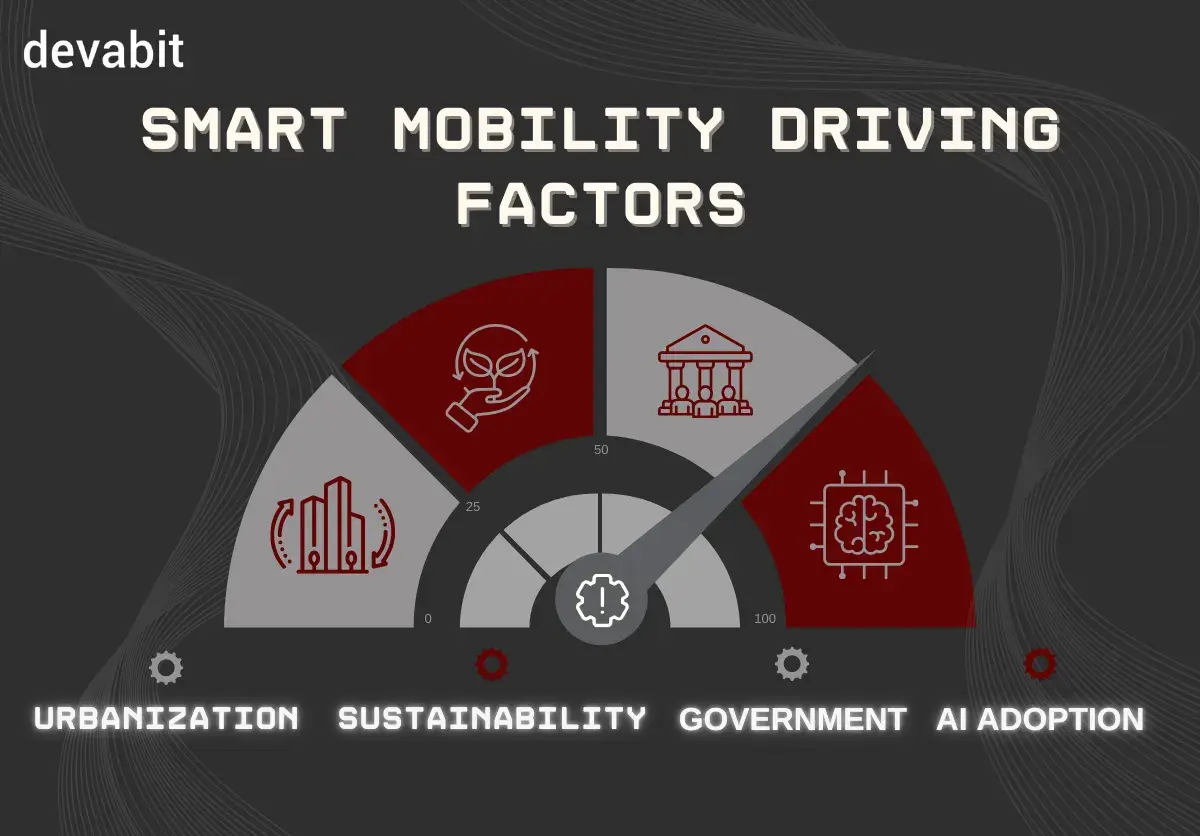
01 / Urbanization
Cities have become too crowded for everyone to own and drive a personal car. Roads are gridlocked, parking is almost impossible, and air quality is terrible. When millions live and work within a few square kilometers, people and governments seem to become willing to accept shared scooters, ride-hailing, one-way car-sharing, and autonomous shuttles. That density created both the pain and the critical power for smart mobility to finally bloom.
02 / Sustainability
Diesel scandals, deadly smog episodes, and youth climate movements forced cities and companies to act fast. Which is why, electrification, shared vehicles, and routing algorithms that reduce empty miles became the cheapest and fastest ways to cut emissions and local pollutants. At this point, companies see going smart and environmentally conscious not as an option but as a strict imperative.
03 / Governmental Support
Governments stopped treating mobility as neutral infrastructure and started actively reshaping it. They used the full toolbox: massive subsidies for EVs and charging networks, bans on combustion engines, congestion charges, and low-emission zones that punish old vehicles. These vital changes removed the biggest barriers, like high cost, regulatory uncertainty, and lack of infrastructure, and turned experiments into scalable businesses promptly.
04 / AI Adoption Spread
And here it comes. Our key player in this merciless game. Powerful, cheap AI (especially Edge AI Software) solved the practical problems that previously kept smart mobility stuck. It made vehicles see and react like skilled human drivers, turned traffic lights into real-time optimizers, and allowed fleets to predict demand minute-by-minute. Once AI reached the point where it was reliable, low-power, and affordable enough to embed everywhere, the core technologies of autonomy, sharing, electrification, and intelligent infrastructure finally worked in the real world at a reasonable cost. And that shift was a literal game-changer, showing how smart mobility is transforming from an option to a must-have.
What Are Real-World Examples of Edge AI Software in Smart Mobility?
Answering the key question, today we will explore a few demonstrative examples of the Edge AI Software in the smart mobility sector. These implementations highlight how on-device AI processing delivers low-latency decisions, enhances safety, and optimizes urban flow, crucial for scaling from pilots to everyday use. We will particularly focus on three key areas of the Edge AI Software in smart mobility.
01 / Mobility as a Service (MaaS)
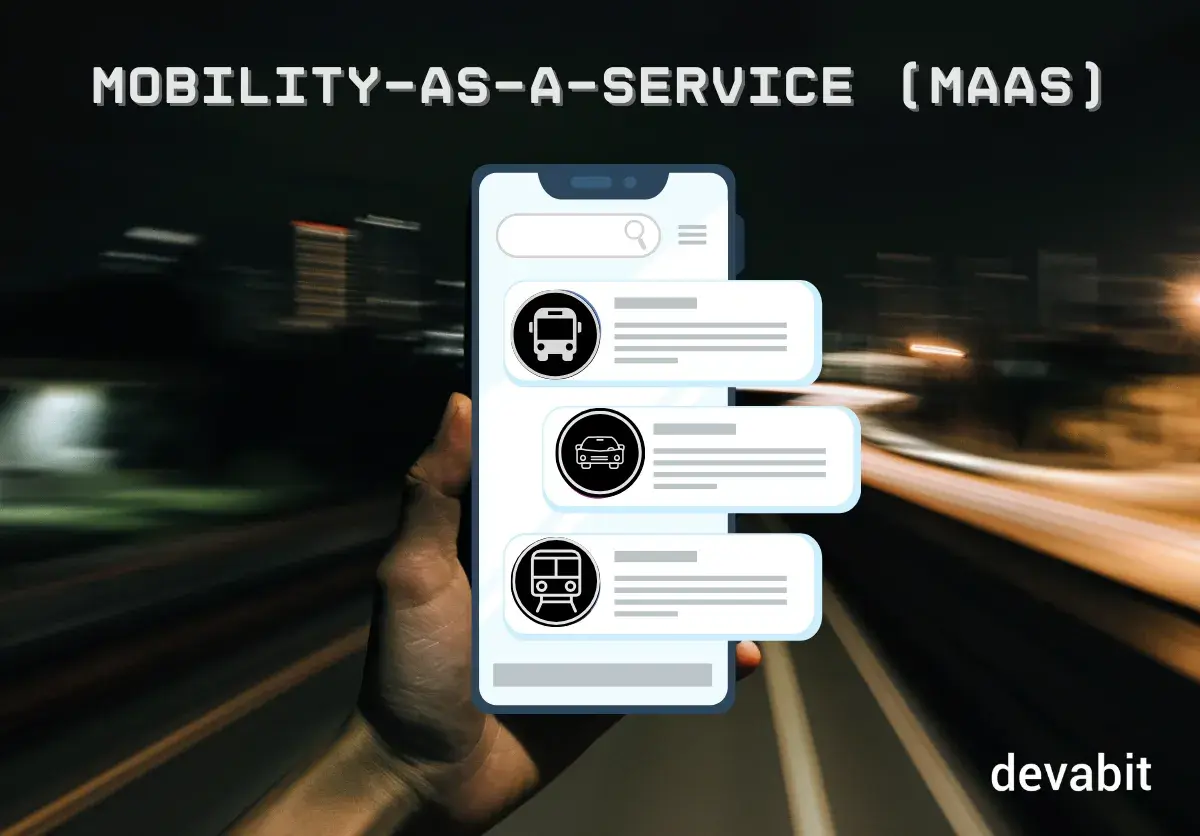
If you thought that Edge AI Software in smart mobility is only about autonomous cars and smart driving systems, we are here to prove you wrong with MaaS.
Mobility-as-a-Service (MaaS) is the idea that people no longer need to own a car (or bike, or scooter). Instead, they subscribe to or pay per use for all their daily travel needs through one single app and one payment. Yes, remember when ordering a quick ride to the airport, you are not just commuting from one place to another, but you become a part of a huge connected system called Mobility as a Service. And of course, anything of the above-mentioned could be possible with the Edge AI Software integration.
Whim (Helsinki & Antwerp) is the world’s most mature MaaS app, covering public transit, city bikes, e-scooters, taxis, and rental cars in one subscription. An excellent example and opportunity to observe the Edge AI software in all its glory.
02 / Instant Crash Avoidance
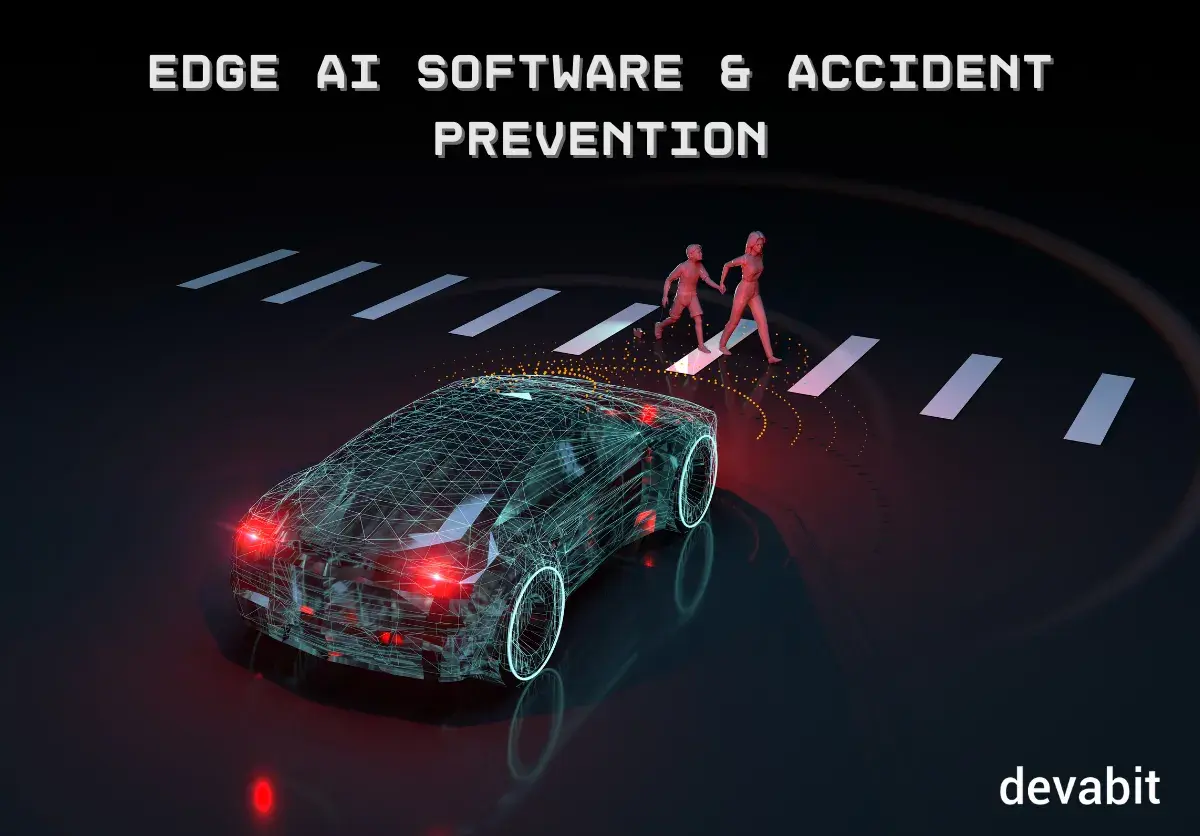
The case when the Edge AI software becomes your life saver is more than worth mentioning on our list. Edge AI Software runs directly inside the vehicle, or on roadside units, and reacts in milliseconds, far faster than any cloud-based system.
Edge AI Software has become the single most effective tool for cutting real-world car accident rates because it removes the two biggest historical killers of road safety: human reaction time and delayed or missing information.
Where a human driver needs 1.5–2.5 seconds to notice danger, decide, and start braking, Edge AI Software runs directly on the car’s chips, sees the same danger, decides, and begins braking or steering in 30–70 milliseconds. 20–50 times faster. Impressive, isn't it?
This speed alone turns thousands of unavoidable crashes into near-misses every day. In Tesla’s 2025 data, for example, edge-only automatic emergency braking and evasive steering now prevent roughly five potentially severe crashes for every million miles driven, a rate almost impossible to achieve with human drivers or cloud-dependent systems.
And now let's have a closer look at how exactly Edge AI Software prevents a potential car accident or a vehicle failure.
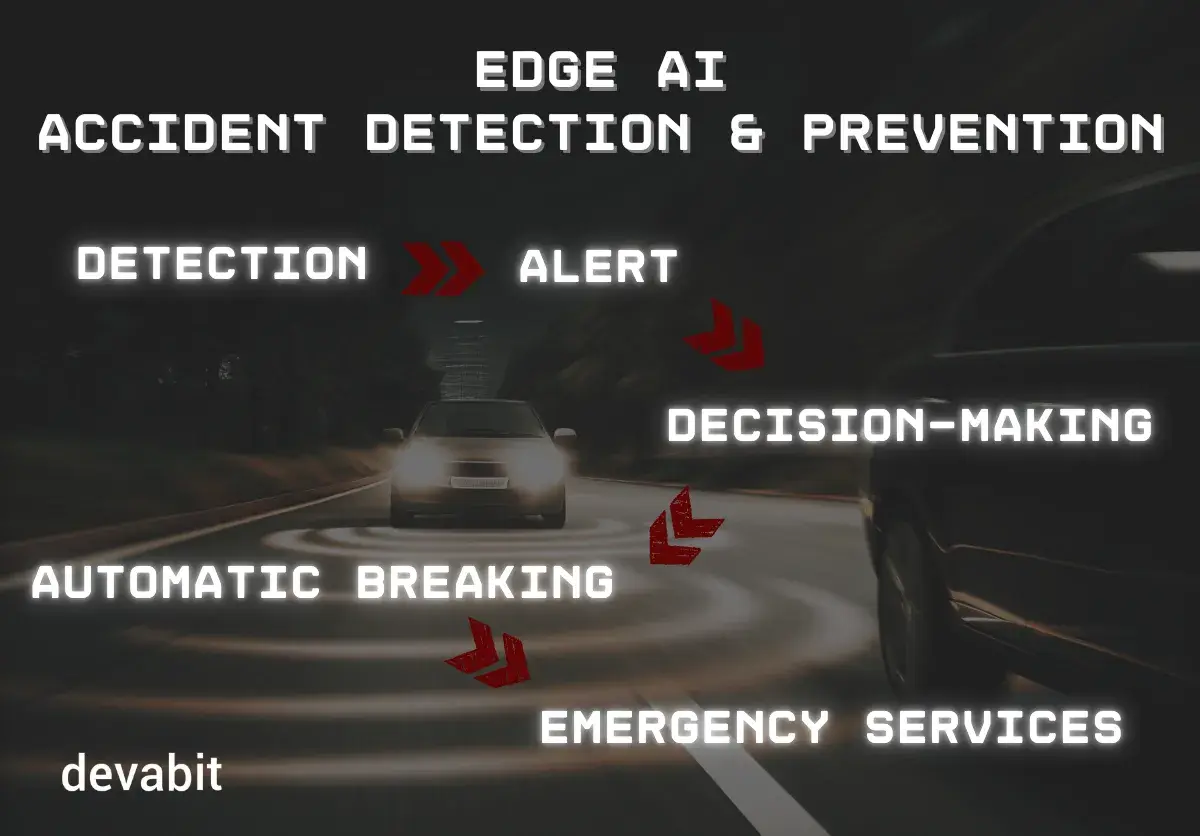
Simply put, Edge AI Software follows this algorithm to prevent the potential road accident:
- Threat detection via numerous sensors, cameras, and connected data.
- Data analysis within milliseconds.
- Alert sent to the internal edge system (vehicle).
- Instant decision-making process.
- Automatic road accident prevention actions are taken. (Braking, signaling, driver attention stimulation, etc)
- Other emergency services will be taken if needed.
03 / Connected & Autonomous Vehicles (CAVs)
In CAVs, Edge AI Software processes sensor fusion (LIDAR, cameras, radars) onboard for split-second maneuvers, ensuring operation in connectivity blackouts. A prime example is Tesla's Full Self-Driving (FSD) software, running on custom FSD chips with neural networks for object detection and path prediction. It handles real-time lane changes and pedestrian avoidance at less than 50 ms latency, powering over 2 million vehicles globally.
What Are the Advantages of Using Edge AI Software in Vehicles?
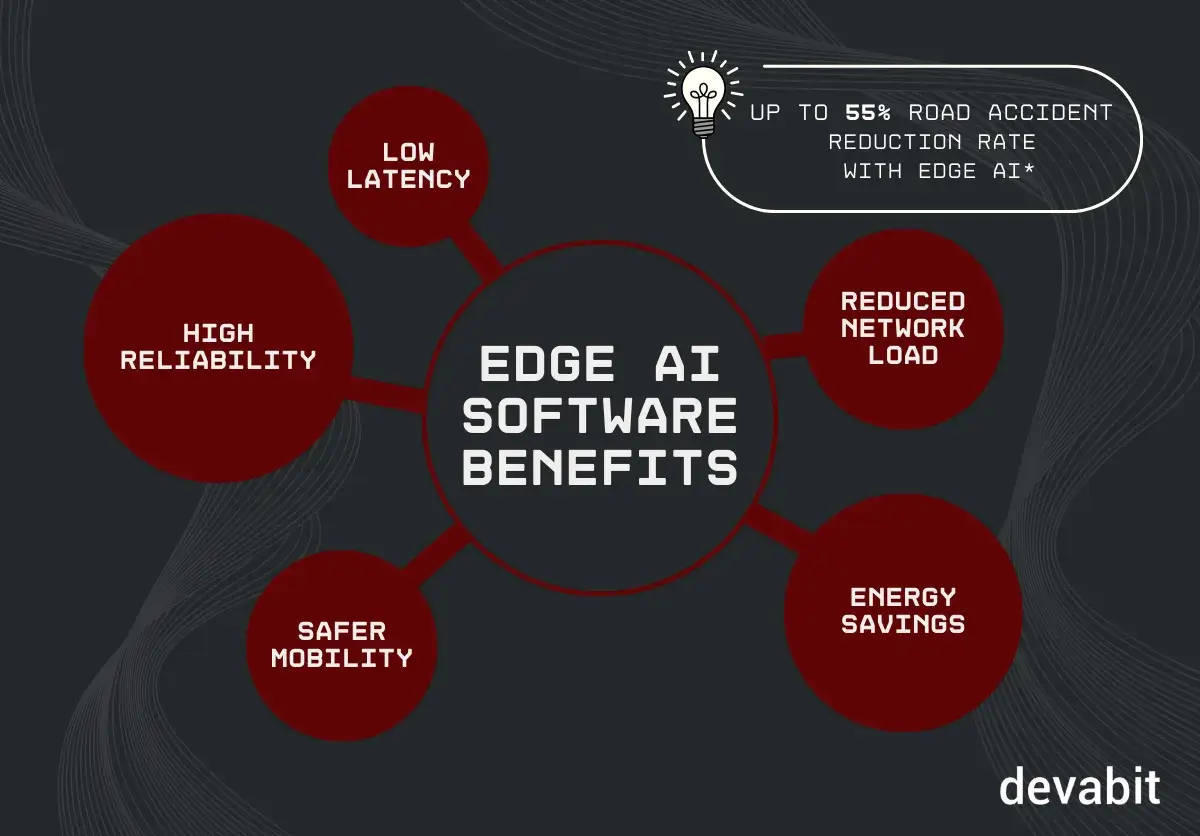
Previously, we briefly talked about how Edge AI Software contributes to enhancing driver experiences, and now it is time to have a look at a few more advantages we can observe.
Low Latency
Edge
AI Software processes data directly on the vehicle (or on nearby edge
devices) rather than sending it to distant cloud servers. This
eliminates round-trip delays that can exceed 100-200 ms in cloud-based systems. In
critical driving scenarios, such as emergency braking, pedestrian
detection, or lane-keeping, reaction times drop to milliseconds.
High Reliability
By reducing dependency on constant internet connectivity, Edge AI Software ensures that essential functions continue working even in areas with poor network coverage, like tunnels, rural roads, or underground parking. The vehicle no longer "goes blind" when the cellular signal drops. Critical safety and navigation features remain operational because the Edge AI Software lives locally on the car’s hardware.
Safer Mobility
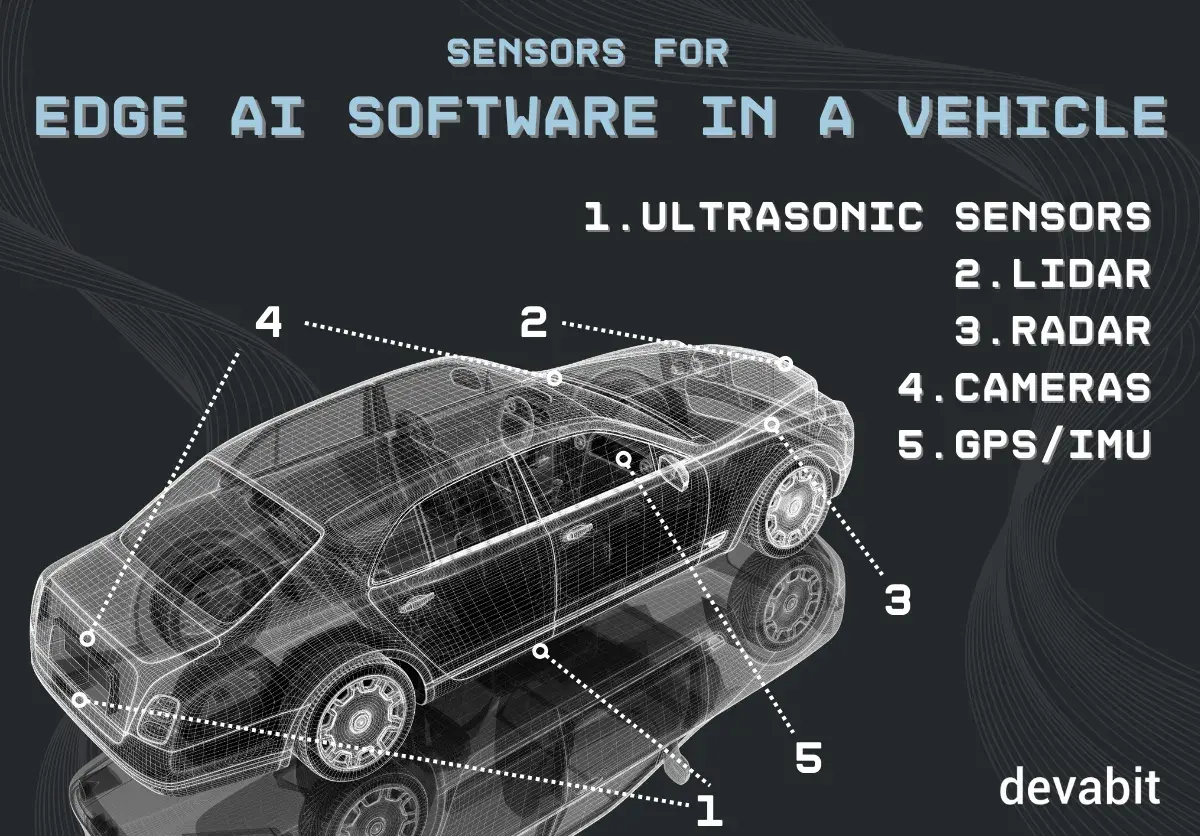
Edge AI Software enables real-time analysis of sensor data via ultrasonic sensors, LiDARs (Light Detection and Ranging), radars, cameras, GPS (Global Positioning System),and IMUs (International Measurement Units) without the risks associated with network lag or outages. Features such as precise pedestrian and cyclist detection, accurate traffic-sign recognition in all lighting conditions, or instant collision avoidance and automatic emergency braking are all possible thanks to Edge AI Software and sensible vehicle hardware.
Energy Savings
Processing data with the Edge AI Software dramatically reduces the amount of raw information that needs to be transmitted wirelessly. Sending compressed insights or decisions instead of continuous high-resolution video streams consumes far less power at the radio level. This translates into longer battery range for electric vehicles, reduced thermal load on in-car systems, and lower overall energy consumption of the mobility ecosystem.
Reduced Network Load
And finally, today’s connected vehicles can generate thousands of terabytes of data per day. Uploading even a fraction of that to the cloud would overwhelm networks and create massive infrastructure costs. In contrast, Edge AI Software filters and processes 95-99% of this data locally, sending only high-value, summarized information, like anomaly reports, map updates, or learned driving patterns, to the cloud when connectivity is available.
How Devabit Can Help
In case, reading all of the Edge AI Software benefits sparks pure inspiration and craving to bring it to your smart mobility business, devabit expertise is exactly what you need! Our custom automotive software development company specializes at delivering unique driver experiences through tailored cross-platform solutions, AI-driven analytics, predictive and preventive maintenance systems — anything to transform a ride into an unforgettable journey. Take a look at some of our brightest Edge AI Software implementation options:
Event & Incident Detection
Real-time recognition of collisions, hard braking, rollovers, or impacts using on-device threshold- and model-based detection combined with accelerometer and camera data fusion.
Predictive Maintenance & Diagnostics
Continuous monitoring of battery, brakes, motors, and other critical components to predict failures through edge-based anomaly detection, trend analysis, and multi-sensor fusion.
Infotainment, Personalization & Voice Assistants
Context-aware recommendations, adaptive user interfaces, and responsive voice interaction powered by local or hybrid speech recognition, natural language processing, and driver preference modeling.
V2X, Cooperative Perception & Shared Mapping
Enabling vehicles and roadside infrastructure to share real-time perception data, like seeing around corners or detecting hidden obstacles, through ultra-low-latency distributed inference, computation offloading, and dynamic map fusion.
Road & Surface Condition Monitoring with Anomaly Alerts
Instant detection of potholes, slippery surfaces, or loss-of-control situations using fused data from the vehicle’s IMU, additional road sensors, and locally trained machine-learning models.
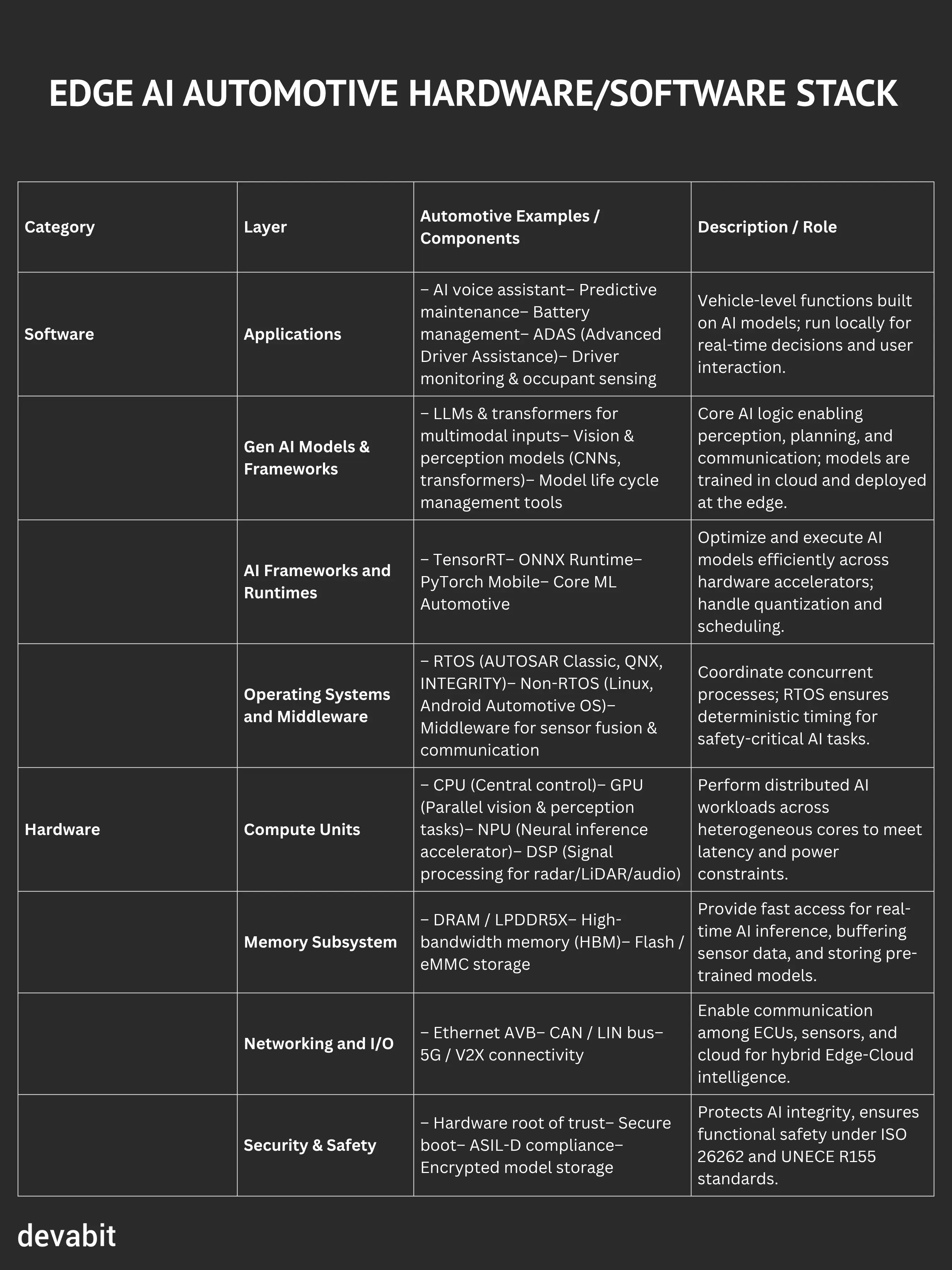
Edge AI Software in Smart Mobility: Crossing the Finish Line
From real-time incident detection and predictive maintenance to personalized infotainment, cooperative V2X perception, and instant road-condition awareness, Edge AI Software solutions are turning today’s connected cars into truly autonomous, efficient, and safe mobility platforms. The Edge AI Software finally made it possible to have a car in your smartphone and your smartphone in a car. And most importantly, all without relying on cloud servers or internet connection. While we thought that cloud development or serverless computing is a peak of data processing, Edge AI Software patiently waited for its moment of glory.

Smart marketing, smart teams, smart management, and the only smart thing lacking is vehicles. If that statement is all about your business, devabit knows how to help! Contact Us to receive a free quick note for your smart mobility business, custom automotive solutions, and Edge AI Software implementation. Do not hesitate to leverage the full power of AI-driven vehicles for your unique needs. And devabit consulting services and custom automotive software development are here to dispell any of your concerns.
Recent Publications
Don't miss out! Click here to stay in touch.
More of AI Content

Relevant Articles View all categories
View all categories CONNECT WITH US WE’RE READY
TO TALK OPPORTUNITIES
THANK YOU! WE RECEIVED YOUR MESSAGE.
Sorry
something went wrong