

AI Chatbot Development: Do You Really Need It?
Picture this: it is 11:47 PM, perfect late-night shopping time, a potential customer is ready to buy, but they have one quick question… and your team is offline. In the past, that moment would have been lost revenue. Today, it is exactly where AI chatbots shine, answering instantly, guiding users, and keeping conversations moving 24/7. AI chatbots are becoming a primary customer service channel for roughly 25% of organizations by 2027, according to Gartner. On top of that, businesses are increasingly investing in AI tools as they move from experimentation to daily operations, with corporate spending on OpenAI models hitting record levels in late 2025. That is why devabit decided to put all the dots above the i's and discover how customers expect faster responses than ever, teams are under pressure to do more with less, and companies are looking for smarter ways to scale without sacrificing service quality. In this article, we will break down what AI chatbots really are, how they differ from traditional chatbots, and how businesses can use them strategically, from customer support and sales to internal knowledge and operations.
Below, you will find:
- What is an AI chatbot?
- An AI chatbot is a conversational assistant powered by artificial intelligence that can understand user messages and respond in a natural, human-like way.
- How is an AI chatbot different from a regular one?
- A regular chatbot follows scripts and rules, while an AI chatbot understands intent, handles complex questions, and adapts responses based on context.
- How does an AI chatbot work?
- It uses natural language processing (NLP) and AI models to interpret what the user means, generate a relevant answer, and improve over time (depending on training and setup).
- What companies offer AI chatbot development services?
- AI chatbot services are offered by AI development agencies, custom software development companies, and automation studios, including both custom developers and platforms like OpenAI partners, Microsoft, Google, IBM, and Salesforce. If you seek less expensive options or consider outsourcing, such custom software development companies as devabit offer high-quality AI chatbot development services at a competitive price on the European market.
- How much does it cost to build an AI chatbot?
- The costs vary widely, depending on such factors as:
- development company of choice;
- tech stacks;
- cooperation model;
- AI chatbot features you need;
- project duration and team size;
- The costs vary widely, depending on such factors as:
- How much time does it take to build an AI chatbot?
- A basic AI chatbot MVP usually takes 2-4 weeks, while more advanced solutions can take 1-3+ months, depending on complexity and integrations.
Want to know even more? Read along!
- What Is AI Chatbot? AI Chatbot Definition in Simple Terms
- How Does an AI Chatbot Work?
- What Is the Difference Between a Chatbot and an AI Chatbot?
- AI Chatbot for Business: Use Cases
- AI Chatbot Examples by Industry
- AI Chatbot Ideas You Can Launch Quickly
- Does Your Business Need AI Chatbot Development Services?
- AI Chatbot Development: Must-Have or an Extra Expense?
What Is an AI Chatbot? AI Chatbot Definition in Simple Terms
An AI chatbot is a smart computer program designed to talk with people in a natural, human-like way. Instead of needing a real person on the other side of the screen, an AI chatbot can answer questions, guide users, and provide support automatically, often within only seconds.
You can find AI chatbots on websites, mobile apps, online stores, banking platforms, and even in social media messaging. In simple terms, an AI chatbot is a digital assistant powered by Artificial Intelligence that can understand what you mean and respond in a helpful way.
Its main goal is to simulate conversation and make interaction feel smooth and effortless. Unlike older systems that only follow strict scripts, many modern AI chatbots can understand different ways people ask the same question and still provide the right answer. For example, whether you type:
- "Where is my order?"
- "Can I track my delivery?"
- "When will my package arrive?"
A well-built AI chatbot can recognize that all of these questions are about the same topic and respond accordingly. But how exactly do AI chatbots achieve this level of user engagement and helpfulness? Let's delve into it together.
How Does an AI Chatbot Work?
An AI chatbot works by receiving your message, understanding what you mean, and generating the best possible reply, all within seconds. While it may feel like you are chatting with a real person, everything happens through a combination of language technology, AI models, and automated decision-making systems working behind the scenes. To understand it clearly, let's break down the process step by step.
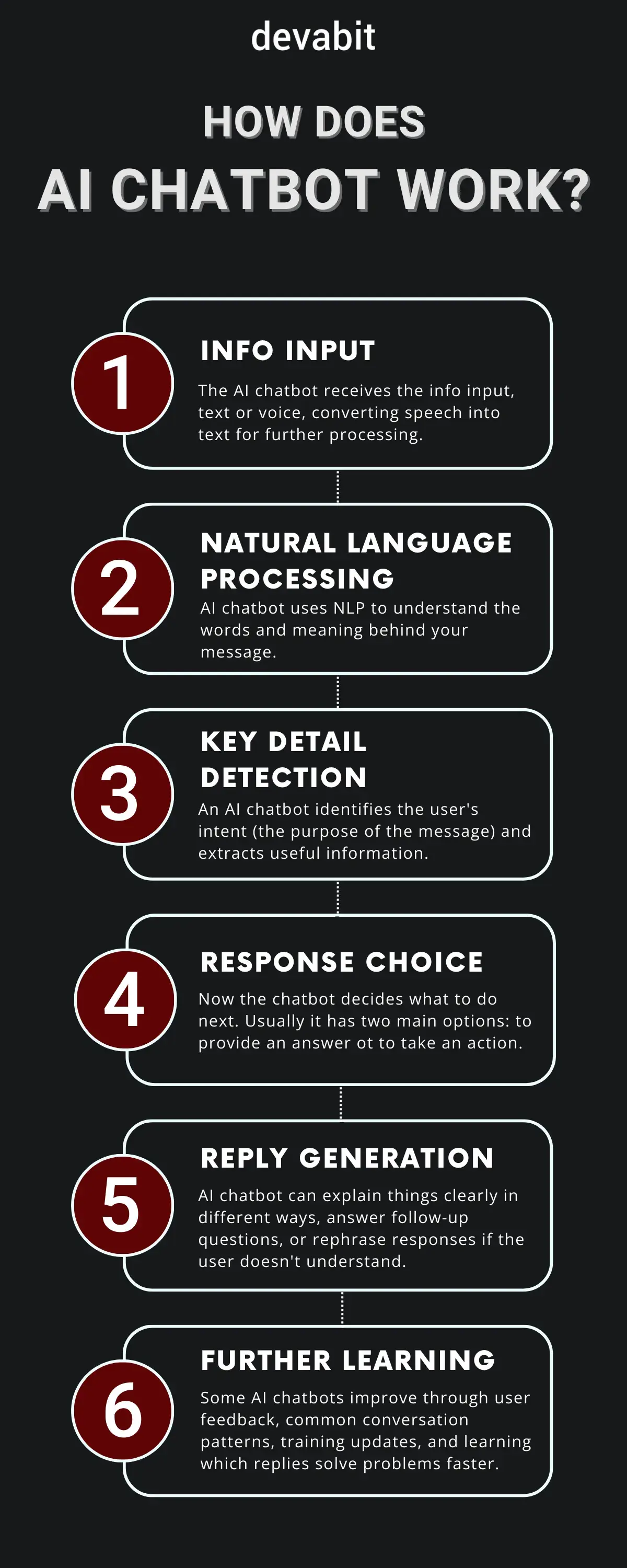
01 / The AI Chatbot Receives Your Input (Text or Voice)
The conversation starts when a user types a question, such as: "Can I change my delivery address?" or speaks it through voice chat. If the AI chatbot supports voice, it first converts speech into text using speech recognition. From there, the chatbot processes the message as written language.
02 / Understanding the Message Using Natural Language Processing (NLP)
Next, the AI chatbot uses Natural Language Processing (NLP) to understand the words and meaning behind your message. This step is crucial for chatbots because people do not always write perfectly. For example, users might type:
- "Where my order??"
- "Order tracking pls"
- "When is it arriving?"
NLP helps the AI chatbot recognize that these different messages are all asking about order status or tracking. At this stage, the AI chatbot tries to figure out:
- What the user is asking;
- What topic the message is about;
- What the user's goal is;
- Whether the user sounds confused, urgent, or frustrated.
03 / AI Chatbot Detects Intent and Key Details
Once the AI chatbot understands the message, it identifies the user's intent (the purpose of the message) and pulls out the most useful information. For example, in the message: "I need to cancel my subscription before next month." The chatbot may detect:
- Intent: cancel subscription;
- Important detail: "before next month" (time limit).
This step is what makes AI chatbots feel "smart," because they can interpret real-world language rather than only responding to exact keywords.
04 / It Chooses the Best Response or Takes an Action
Now the AI chatbot decides what to do next. Usually, it has two main options:
Option 1: Provide an Answer
If the user asks something simple, the AI chatbot can respond immediately: "What are your working hours?" → it replies with business hours.
Option 2: Perform an Action
If the user needs help with a task, the AI chatbot might connect to tools or databases, such as:
- Order tracking system;
- Booking schedule;
- Customer account profile;
- Payment or subscription system;
- Shipping or delivery platform.
05 / It Generates a Human-Like Reply
Innovative AI chatbots, especially those powered by Generative AI, create responses in a natural style that sounds conversational. This approach is different from traditional chatbots that only pick a reply from a list. A generative AI chatbot can:
- Explain things clearly in different ways;
- Answer follow-up questions; rephrase responses if the user doesn't understand;
- Adjust tone (professional, friendly, short, detailed).
That is why many AI chatbots feel more like an assistant than a robot.
06 / It Learns and Improves Over Time
Some AI chatbots improve through:
- User feedback (thumbs up/down);
- Common conversation patterns;
- Training updates made by developers;
- Learning which replies solve problems faster.
However, it is important to understand that not every AI chatbot learns instantly from each conversation. Many companies improve chatbots by retraining them in updates, rather than letting them change in real time.
What Is the Difference Between a Chatbot and an AI Chatbot?
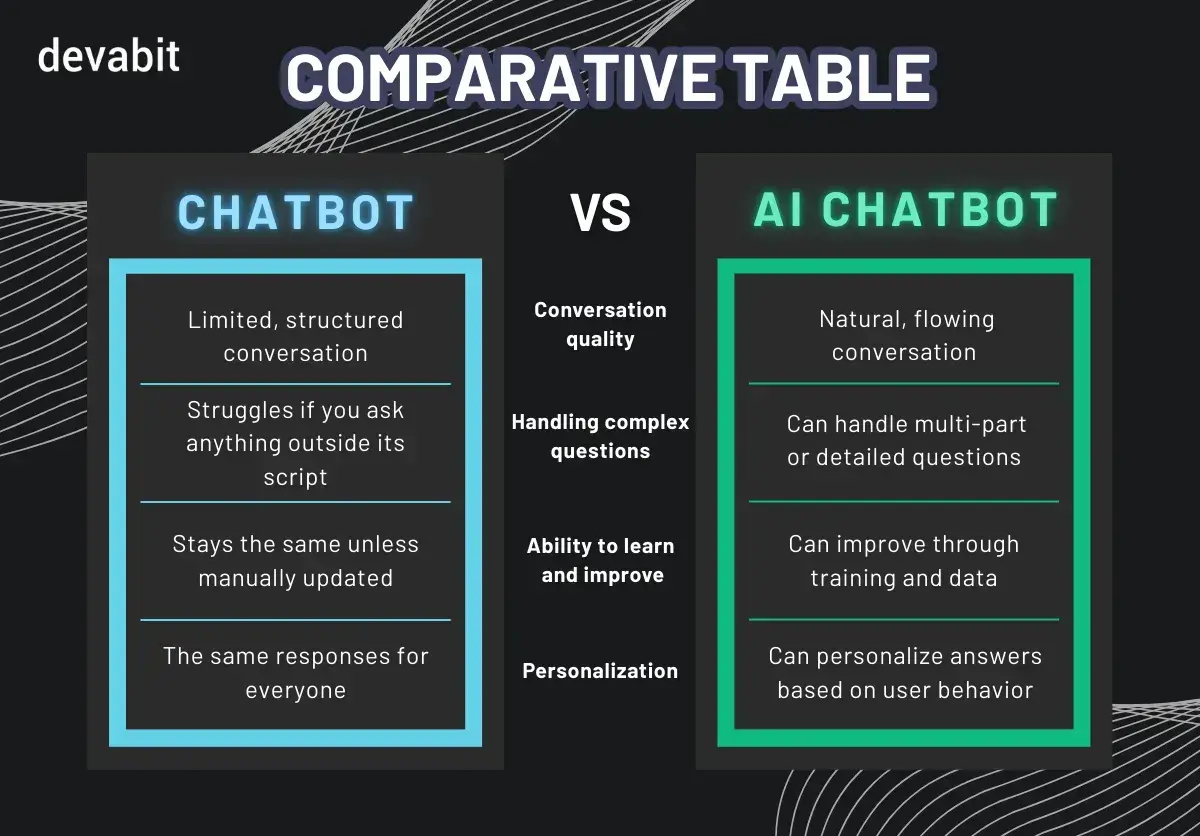
At first glance, a chatbot and an AI chatbot may seem like the same thing. Both can answer questions, respond to customers, and simulate a conversation in real time. But under the hood, they work in completely different ways, and that difference affects everything from how effective they feel to how useful they are for real business tasks. The simplest way to understand the difference is this: A traditional chatbot follows a script. An AI chatbot understands language and generates responses. Now let’s break it down clearly.
What Is a Chatbot?
A chatbot is a conversational program that responds to user input using predefined rules. It is usually built around a flowchart-style structure, where each answer depends on keywords, buttons, or fixed menu options. Most traditional chatbots rely on:
- If/then rules;
- Decision trees;
- Pre-written responses;
- Keyword detection.
Because of this, chatbots are predictable and consistent, but also limited. They perform best when users ask questions in a way the chatbot expects.
When traditional chatbots work well
Chatbots are a great fit for simple and repetitive tasks, such as:
- Answering FAQ questions ("What are your business hours?")
- Order tracking ("Where is my package?")
- Booking appointments;
- Basic customer support routing ("Press A for..., B for…")
What Is an AI Chatbot?
An AI chatbot is a more advanced conversational system powered by artificial intelligence, usually using technologies such as:
- Natural Language Processing (NLP);
- Machine learning;
- Large Language Models (LLMs).
Instead of selecting a response from a fixed list, an AI chatbot can generate a response based on what the user means. That is why AI chatbots feel more natural, more human, and more helpful during real conversations.
What makes AI chatbots more powerful
AI chatbots can often:
- Understand intent even when messages are unclear or incomplete;
- Respond in full sentences with natural language;
- Handle follow-up questions without restarting the conversation;
- Adapt tone and answers depending on context;
- Provide personalized recommendations or support;
The Core Difference
The biggest difference between a chatbot and an AI chatbot comes down to the way each one responds. Traditional chatbots match keywords and pick a pre-written response. Meanwhile, an AI chatbot interprets meaning and generates an informed response in real time.
Most of you would recognise these features in a tool we cannot imagine our everyday search without. Yes, we are talking about ChatGPT. But are AI chatbots and ChatGPT really that similar?
Are AI Chatbots the Same as ChatGPT?
AI chatbots are any chatbots powered by artificial intelligence, typically using natural language processing (NLP) and machine learning to understand and respond to users. ChatGPT is a specific AI chatbot created by OpenAI, built on a powerful large language model (LLM) designed for natural, human-like conversations.
So while ChatGPT is an AI chatbot, not every AI chatbot is ChatGPT.
Do AI Chatbots Really Understand Users or Just Guess?
When people say an AI chatbot "understands," they usually mean it can follow what you mean (even if you phrase it oddly), respond appropriately, keep track of context, and solve the problem you brought to it.
AI chatbots can often do those things, but their understanding is statistical, not human.
What AI Chatbots Actually Do:
Most modern AI chatbots (especially those based on large language models) work by reading your message and the surrounding context, identifying patterns and intent from the text, and predicting what words should come next to form the best answer.
So yes, in a technical sense, they are guessing, but it is closer to a highly informed prediction than a blind guess.
AI Chatbot for Business: Use Cases
AI chatbots are quickly becoming one of the most practical tools businesses can implement to improve efficiency, customer experience, and internal productivity. Unlike traditional chatbots that follow fixed scripts, AI chatbots can understand natural language, handle complex questions, and assist users in a conversational way, making them extremely useful across multiple departments. Below, we have gathered the most valuable real-world use cases for an AI chatbot for business, including how they work, where they deliver the biggest impact, and why companies are adopting them so quickly.
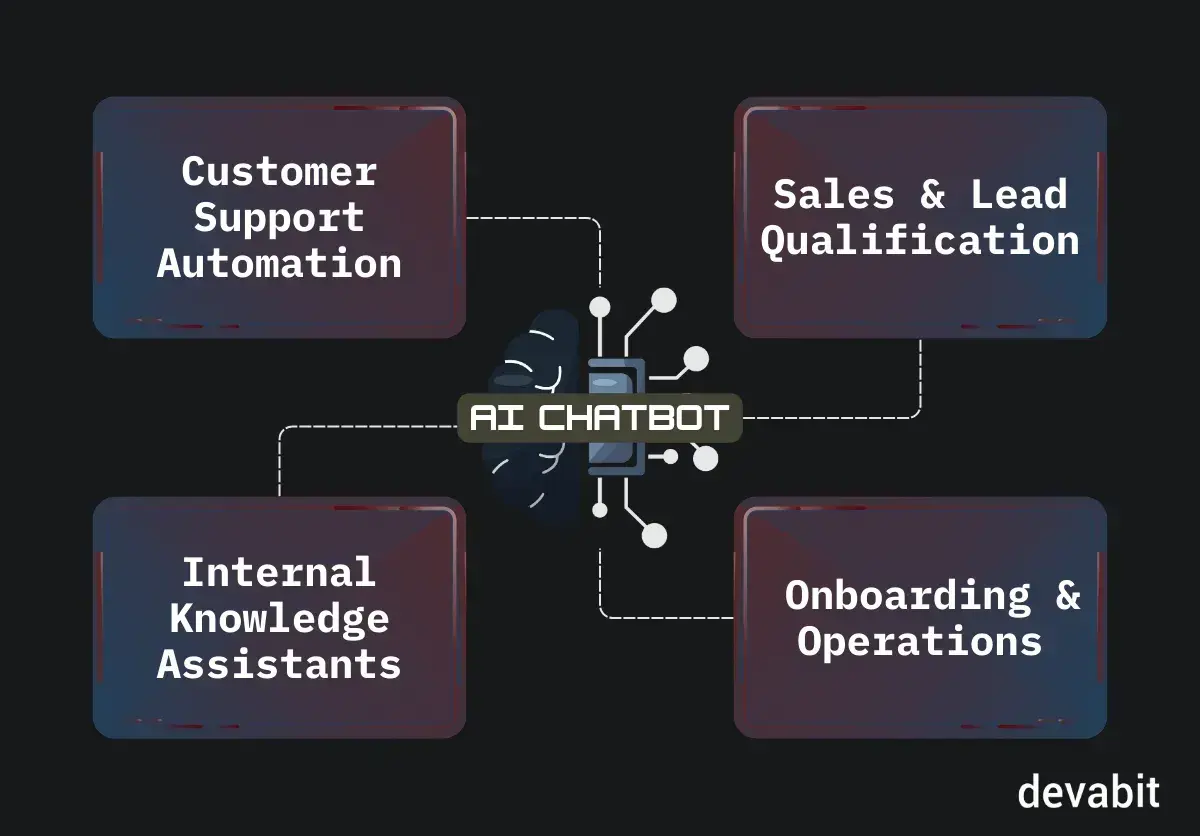
Customer Support Automation
Customer support is one of the most common and high-impact areas for AI chatbot implementation. An AI chatbot can handle repetitive inquiries instantly while still offering a more human-like experience than a rule-based support bot.
What AI Chatbots Can Automate in Customer Support
An AI chatbot can assist with:
- Answering frequently asked questions (shipping, returns, pricing, service coverage);
- Order status checks and delivery updates (when connected to systems);
- Troubleshooting steps for common problems;
- Guiding customers through setup or product usage;
- Escalating to a human agent when needed.
Why It Matters
Customer support teams often spend most of their time answering the same questions. AI chatbots reduce pressure on agents, shorten response times, and help customers get answers without waiting.
Pro tip: The best-performing AI support chatbots combine automation with smooth handoff to humans, so users never feel stuck.
Sales & Lead Qualification
AI chatbots can also be powerful sales assistants. On websites, landing pages, or social channels, an AI chatbot can act as a first-contact sales rep, helping businesses capture leads and guide prospects toward the next step.
How AI Chatbots Support Sales
A sales-focused AI chatbot can:
- Greet visitors and ask discovery questions;
- Recommend products or services based on user needs;
- Answer pricing and feature questions in real time;
- Qualify leads by collecting key information (budget, timeline, goals);
- Schedule meetings or demos;
- Automatically reduce drop-off by keeping users engaged longer.
Why It Matters
Most website visitors leave without taking action. AI chatbots help convert more traffic into conversations, and more conversations into customers. For example, instead of forcing users to fill out a form, an AI chatbot can ask a few quick questions and then recommend the best plan or package.

Internal Knowledge Assistants
One of the most underrated use cases for AI chatbots is internal productivity. Many companies struggle with scattered information across emails, PDFs, policy documents, Slack messages, and shared drives. An AI chatbot can serve as an internal search-and-answer assistant for employees.
What an Internal AI Chatbot Can Help With
Internal AI knowledge assistants can answer questions like:
- "Where is the latest brand guideline document?"
- "What is the process for submitting a client refund request?"
- "How do I request access to a tool?"
- "What are the approved contract templates?"
Instead of searching through folders or asking coworkers repeatedly, employees can simply ask the chatbot in plain language.
Why It Matters
Lost time searching for information is one of the biggest hidden productivity costs in modern businesses. Internal AI chatbots reduce delays and improve consistency.
HR, Onboarding, and Operations
HR and operations teams handle a large volume of recurring questions, especially in fast-growing companies. AI chatbots help streamline these requests, improve employee experience, and reduce administrative workload.
An HR AI chatbot can support:
- Onboarding guidance for new hires;
- Benefits and policy questions ("How many vacation days do I have?");
- Payroll or payslip directions;
- Requesting time off or submitting forms (depending on integrations);
- Workplace rules and compliance;
- Basics training and development recommendations.
Operations AI chatbots can handle:
- Internal IT help requests and troubleshooting steps;
- Office procedures and facility requests;
- Travel expense policy guidance;
- Procurement workflows and vendor processes;
- Tracking internal tasks and approvals.
Why It Matters
HR teams often become a bottleneck simply because employees need answers quickly. A well-trained AI chatbot can deliver those answers instantly, while HR focuses on strategic work.
Best practice: AI chatbots should know when to escalate to HR (for private or complex issues) and should never replace human support in sensitive situations.
AI Chatbot Examples by Industry
Talking about the efficiency of AI chatbot development services, it is enough to have a look at a few the most famous and profit-making AI chatbot examples, and ask yourself "What prevents my business from reaching the same?". So let's now take a look at top AI chatbot examples by industries below.
01 / E-commerce AI Chatbot Examples
Amazon “Rufus” Shopping Assistant
Built into the Amazon Shopping app/website, Rufus lets customers ask natural-language questions like product comparisons, suitability, and feature clarifications to make purchase decisions faster.
Shopify “Sidekick” AI Assistant for Merchants
Sidekick is a generative AI assistant inside Shopify that helps store owners with tasks like analyzing store performance, executing admin actions, and getting commerce-specific guidance using Shopify data and permissions.
H&M "Generative AI Chatbot" for Customer Service
H&M offers a generative AI chatbot for 24/7 customer support, commonly used for order questions, returns, and general help, reducing the load on human agents.
Target’s Conversational Shopping Experience in ChatGPT
Target announced a curated conversational shopping experience within ChatGPT that supports browsing and multi-item purchasing in one transaction (positioning chat as a new storefront).
02 / Finance AI Chatbot Examples
Bank of America "Erica" Virtual Financial Assistant
Erica is Bank of America’s in-app assistant for common banking tasks, like account info, transactions, and payments. Bank of America has reported billions of interactions since launch.
Capital One "Eno" Virtual Assistant
Eno helps customers manage accounts and provides spending-related insights. It is available via app/online chat, and in some cases text-based support experiences.
Wells Fargo "Fargo" Virtual Assistant
Fargo is Wells Fargo’s mobile-app virtual assistant designed to answer questions, provide shortcuts, and surface insights for everyday banking needs.
Klarna "AI Assistant" Customer Service for Fintech
Klarna launched an AI assistant for customer service chats and publicly reported that it handled a large share of customer service conversations early on.
03 / Healthcare AI Chatbot Examples
Ada Health "Ada" AI Symptom Assessment
Ada is an AI-powered symptom assessment tool designed to guide users through questions and offer health information and next-step suggestions.
Buoy Health, AI Health Assistant / Symptom Checker
Buoy provides an AI-driven symptom-checking experience that asks follow-up questions and helps users decide what kind of care might be appropriate.
K Health, AI + Clinical Care Platform
K Health uses AI to support symptom checking and then connects users to medical providers for care, often positioned as AI-assisted, clinician-backed care.
04 / Logistics AI Chatbot Examples
UPS "UPS Bot" Tracking & Shipping via Chat
UPS has offered a chatbot experience, notably through messaging platforms, to help users with package tracking and shipping-related questions.
DHL Global Forwarding "myDHLi Generative AI Assistant"
DHL has introduced a generative AI assistant in myDHLi to help customers with support questions like shipment status and contact details via a 24/7 AI chatbot.
DHL Freight "VIVA" AI Chatbot for Customer Service
DHL Freight describes VIVA as an AI chatbot handling topics like shipment tracking, complaint support, and product/service questions across languages.
FedEx "Intelligent Virtual Assistant"
FedEx references using an Intelligent Virtual Assistant as an AI-powered chatbot to help advise customers on shipping and related support needs.
AI Chatbot Ideas You Can Launch Quickly (Fast MVP Concepts)
When considering AI chatbot development, most of us would mistaken it for something unaffordable and hard-to-maintain. In fact, launchig a basic AI chatbot takes way less time and resources than you may have feared. These AI chatbot development ideas are perfect if you want to launch in days or a few weeks, not months. And if business upgrade ideas were hitting you hard, but you hesitated, this is your sign to test one of your best ideas!
01 / AI FAQ Chatbot for Your Website
- Best for: small businesses, service providers, coaches, agencies;
- Goal: reduce repetitive messages and speed up customer replies;
- What it does: answers common questions, like pricing, availability, delivery, services, shares links to relevant pages, collects basic customer info before handoff;
- Why it is quick to launch: You can build such an AI chatbot using only your existing website content + FAQ page.
02 / AI Appointment Booking & Scheduling Assistant
- Best for: beauty services, clinics, consultants, tutors;
- Goal: convert more leads into booked sessions;
- What it does: asks what service the user needs, suggests available slots, confirms the booking details, shares location, rules, and prep instructions.
- Quick win: Even without full calendar integration, it can still qualify leads and prepare the booking request.
03 / AI Product Finder for Online Stores
- Best for: e-commerce brands and marketplaces;
- Goal: help shoppers find the right product faster;
- What it does: asks clarifying questions, like "budget?", "size?", "use case?", recommends best matches, compares products in simple terms, suggests upgrades or bundles;
- Why it is powerful: It turns browsing into a guided sales conversation for your potential customers.
04 / AI Customer Support Reply Draft Generator
- Best for: teams handling DMs, email support, tickets;
- Goal: speed up support without replacing humans;
- What it does: generates high-quality reply drafts, keeps tone consistent (friendly, professional, brand-aligned), supports multiple languages, summarizes the issue and recommended response.
- Why it is fast to launch: No user-facing risk. You can launch it internally first.
05 / AI Lead Qualification Chatbot for Landing Pages
- Best for: agencies, B2B services, real estate, SaaS.
- Goal: capture better leads automatically.
- What it does: asks 4-6 smart questions, qualifies leads (budget, timeline, needs), sends the lead to a CRM or email, routes users to the right offer.
- Quick win: Even a simple conversation form chatbot can outperform long forms.
Does Your Business Need AI Chatbot Development Services?
Not every business needs a custom AI chatbot, but many think they don’t, when they actually do. The real question is whether your business has reached the point where professional AI chatbot development makes sense. So let;s see if it is a match!

Signs Your Business Does Need AI Chatbot Development Services
If you recognize several of the points below, custom AI chatbot development is a smart investment for your specific business.
- You receive repetitive questions every day. If your team repeatedly answers the same questions, about pricing, availability, delivery, policies, or basic usage. An AI chatbot can handle these instantly and consistently.
- Your response time affects revenue or customer satisfaction. If delayed replies mean lost sales, abandoned carts, or frustrated customers, automation becomes critical. AI chatbots can respond 24/7, qualify your leads outside business hours, keep users engaged while human agents are unavailable.
- You want to scale without hiring more staff. Hiring and training new support or sales employees is expensive and slow. An AI chatbot scales instantly and handles increasing demand without proportional cost increases.
- Your business processes are too complex for basic. If your use case involves nuanced customer questions, product or service comparisons, internal documentation, or workflows, then you are already beyond "simple chatbot" territory.
- You need personalization or system integrations. If you want a chatbot to recognize returning users, pull data from CRMs, order systems, or knowledge bases, follow business logic or permissions, you will need professional AI chatbot development.
AI Chatbot Development: Must-Have or an Extra Expense?
AI chatbot development can be a smart, and most importantly, future-proof investment for businesses that want to cut support workload, improve response times, and boost conversions. While local companies may not need custom development right away, fast-growing brands often benefit from an AI chatbot that is tailored to their processes and customer needs. In many cases, the cost quickly pays off through better efficiency, stronger customer experience, and scalable automation. And if you are looking to implement an AI chatbot that actually delivers results, our AI chatbot development services are designed to help businesses automate customer support, qualify leads, and streamline internal workflows with secure, scalable, and fully customized solutions.
At devabit, we build custom AI chatbots for websites, small and entertprise businesses, and social media, with options for advanced integrations such as CRM systems, help desks, order tracking, and internal knowledge bases, so your chatbot can do real work, not just answer basic questions. From strategy and conversation design to development, deployment, and ongoing optimization, devabit professionals handle the full lifecycle to ensure high accuracy, smooth user experiences, and measurable ROI. Contact Us for a business-first approach, fast turnaround, and chatbots tailored to your industry, brand voice, and growth goals.
Recent Publications
Don't miss out! Click here to stay in touch.
Interested in AI?

Relevant Articles View all categories
View all categories CONNECT WITH US WE’RE READY
TO TALK OPPORTUNITIES
THANK YOU! WE RECEIVED YOUR MESSAGE.
Sorry
something went wrong