

How to Develop Business Support Systems (BSS) Software: A Practical Guide
As companies mature, operational complexity rarely keeps pace with an ever-changing business context. What worked for ten customers starts to strain at one thousand. Manual billing adjustments that once took minutes begin consuming hours. Reporting that used to feel clear becomes spread across tools. Typically, this is the point when company owners begin asking a more profound question: Do we need a proper business support system? Before diving into architecture or technology choices, it's essential to clarify what we're actually building. Business support systems (BSS) are not just billing software but the digital foundation that connects customers, products, pricing, payments, and revenue management into one coherent environment. At devabit, we've seen companies delay BSS modernization because their existing setup "still works." Well, technically, it does. However, the problem grows quietly in the background (in workarounds, integration patches, and slowed product launches). The one clear thing: developing modern business support systems is less about replacing software and more about preparing the business for scale.
In short, below we will explore the following topics:
- How devabit defines a business support system (BSS) as the commercial backbone that connects customer management, billing logic, product configuration, and revenue tracking into one scalable platform.
- What a business support system actually includes, from customer data and order workflows to billing engines, reporting architecture, and integration layers, and why it goes far beyond basic invoicing tools.
- Why growing companies outgrow disconnected tools and spreadsheets, especially when expanding into new markets such as Australia or introducing complex pricing models.
- The difference between off-the-shelf business support systems and custom BSS development, and how architectural flexibility directly impacts long-term scalability.
- How our team approaches business support system development, starting with business modeling, designing modular architecture, building configurable billing engines, and ensuring secure, compliant integrations.

- What Is a Business Support System?
- Why Companies Outgrow Basic Systems
- Custom Development vs. Off-the-Shelf Business Support Systems
- Starting the Business Support Systems Development Process the Right Way
- Business Support Systems Architecture Considerations That Matter
- The Billing Engine
- Data, Reporting, and Everything in Between
- Business Support Systems Security and Compliance Considerations
- The Role of a Business Support Systems Development Partner
- Planning for Long-term Business Support Systems Success
- Final Thoughts on Business Support Systems Development
What Is a Business Support System?
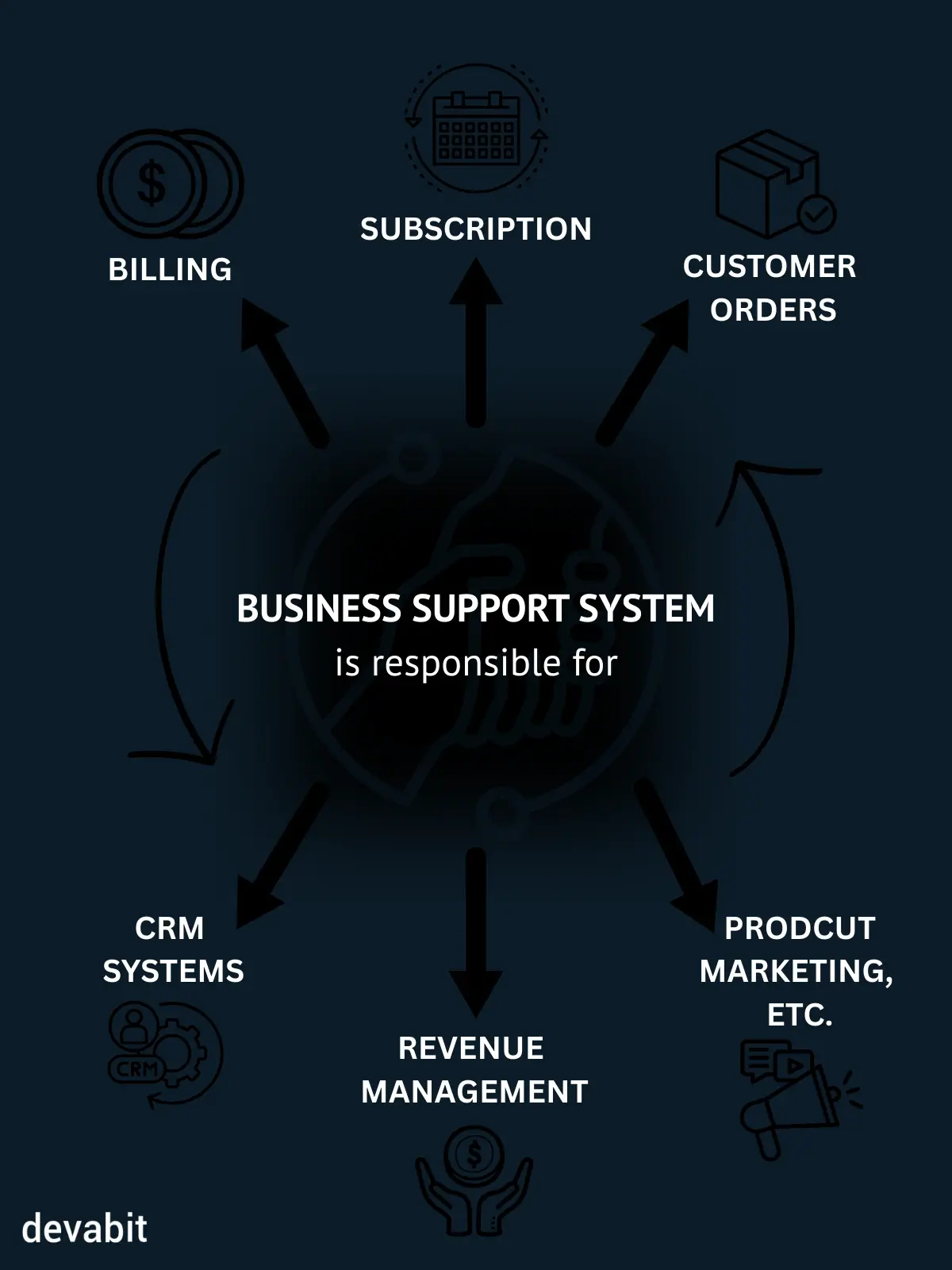
If you search "what is a business support system," you'll find definitions focused on telecom and billing operations. That background is accurate since BSS platforms originated in industries where customer accounts, usage tracking, and complex pricing were core to operations. Yet, the scope is broader today. Business support systems typically manages the following aspects:
- customer data;
- product catalogs;
- order workflows;
- billing logic; invoicing;
- payment processing;
- and revenue reporting.
In telecom, it works alongside OSS (Operational Support Systems). In SaaS, fintech, utilities, and subscription-driven businesses, it plays a similar commercial role. In simple terms, business support systems manage how a company earns and tracks its money. When that system is frozen, every change becomes difficult. When it is flexible and well-designed, pricing, packaging, and expansion become far easier to manage.
Why Companies Outgrow Basic Systems
Many organizations begin with a combination of tools. By way of illustration, a CRM handles customers, while accounting software handles invoices. A subscription plugin, in turn, manages recurring payments. After all, spreadsheets (old but gold) fill in the gaps. This approach works during early growth. But the key issue comes up later.
Consider a SaaS company expanding into international markets, including Australia. Tax rules differ. Currency handling becomes more complex. Some clients negotiate custom pricing. Partners require commission tracking. Suddenly, the original setup feels stretched. Companies offering business support services Australia-wide often face these challenges firsthand. Regulatory requirements and multi-region billing create pressure on systems that were never designed for that scale. The result is operational friction. Not catastrophic failure, just constant inefficiency. That is usually when leadership begins evaluating proper business support systems BSS platform.

Custom Development vs. Off-the-Shelf Business Support Systems BSS
There is no universal answer here. Some off-the-shelf business support systems provide strong foundations, especially when it comes to standardized subscription models. However, businesses with evolving pricing strategies or unique operational workflows often find themselves in trouble. For companies providing business development support services, flexibility is often critical. They may need hybrid billing structures, partner revenue-sharing, or custom bundling that doesn't fit predefined templates.
At devabit, we often work with organizations that initially implemented a packaged BSS solution, only to discover that heavy customization caused long-term limitations. Vendor dependency increased. Release cycles slowed. Adjustments required external consultants. Custom business support systems BSS development requires more upfront planning, but it provides architectural control that matters as monetization models evolve.

Starting the Business Support Systems Development Process the Right Way
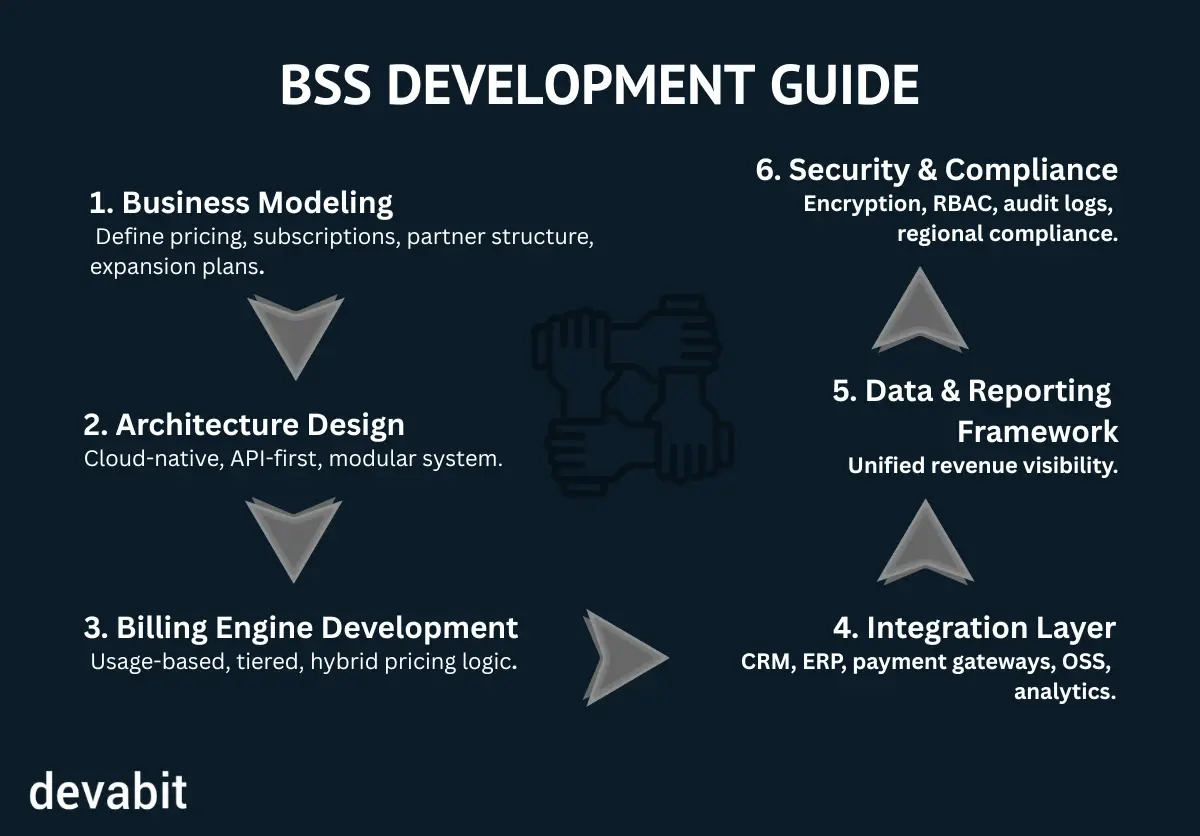
When developing business support systems, the first mistake many teams make is jumping directly into features. Instead, we begin with business modeling.
- What pricing structures exist today?
- What changes are expected in the next three to five years?
- Will the company move toward usage-based billing?
- Is international expansion planned?
These questions, along with many others, shape our architectural decisions. For example, if usage-based billing is likely, the system must support real-time data ingestion and dynamic pricing calculations. If regional expansion is planned, taxation and compliance logic must be modular rather than hardcoded. Subsequently, we believe business support systems BSS should not reflect only current needs but rather accommodate foreseeable growth.
Business Support Systems Architecture Considerations That Matter
From a technical standpoint, modern BSS platforms benefit from modular, cloud-native design. Monolithic systems can function, but they often struggle under increasing transaction volume or frequent feature changes. At devabit, we typically design BSS solutions using a microservices architecture. Billing, customer management, product catalog, and reporting modules operate as independent services. This separation improves scalability and makes updates less risky.
For example, billing cycles often generate peak loads. If billing is isolated as its own service, it can scale independently without affecting customer portals or analytics dashboards. Integration is equally important. Business support systems rarely operate alone. It connects to CRM platforms, ERP systems, payment gateways, analytics tools, and sometimes OSS environments. API-first design simplifies these integrations and reduces long-term maintenance costs.

The Billing Engine
Billing appears straightforward until real-world scenarios are introduced. Flat monthly subscriptions are simple. But many companies require tiered pricing, volume discounts, contract-based pricing, usage thresholds, promotional discounts, or hybrid subscription models. Mid-cycle plan changes add further complexity. Refunds, proration logic, and tax adjustments must be calculated correctly.
One devabit client needed to support both prepaid and postpaid billing within the same platform. Instead of building separate systems, we implemented a configurable billing engine that allowed business users to define pricing rules through an administrative interface. That flexibility reduced dependency on development teams for routine pricing changes. This is where many business support systems struggle. Hardcoded billing logic might work initially, but it becomes difficult to adapt when business models evolve.
Data, Reporting, and Everything in Between
Another overlooked aspect of BSS development is reporting architecture. Leadership relies on accurate revenue data. Finance requires reconciliation accuracy. Product teams want visibility into plan adoption and churn trends. If data flows through disconnected systems, reporting becomes inconsistent. Teams end up debating which numbers are correct rather than focusing on strategy. Well-designed business support systems centralize revenue data and exposes structured analytics. This does not necessarily mean building a massive analytics platform inside the BSS itself, but it does require thoughtful data pipelines and integration with BI tools. At devabit, we treat data modeling as a core part of BSS development, not an afterthought.

Business Support Systems Security and Compliance Considerations
Because business support systems manage financial transactions and personal data, security must be embedded from the beginning. Role-based access control ensures that finance teams, support agents, and administrators only access what they need. Encryption protects sensitive information in transit and at rest. Audit logs create traceability for compliance purposes. Companies operating internationally, including those delivering business support services in Australia, must consider regional regulatory frameworks. Designing compliance logic early avoids costly retrofits later. Security decisions made during architecture design are far easier to implement than those added after deployment.

The Role of a Development Partner
Building business support systems is not just a technical exercise. It requires understanding business operations, revenue strategies, compliance frameworks, and user workflows. We approach BSS development as a collaborative process. Our teams work with product owners, finance departments, and operational managers to map real processes before writing code. This reduces rework and ensures that the final platform reflects actual business behavior rather than theoretical workflows. In several cases, clients discovered inefficiencies in their internal processes during BSS planning workshops. The system redesign became an opportunity to improve operations more broadly.
Planning for Long-term Success of Your Business Support Systems BSS
Technology choices matter, but architectural clarity matters more. Business support systems should not require major restructuring every time the company introduces a new pricing model or enters a new market. If it does, the design was too rigid from the beginning. Scalability is not just about handling higher traffic. It is about handling change. When evaluating how to develop business support systems, consider not only today's feature list but tomorrow's uncertainty.

Final Thoughts on Business Support Systems Development
At the end of the day, it's clear that developing business support systems is a complex yet essential process necessary for most companies that scale. With business support systems BSS by your side, it's easier to handle finance, product management, customer support, compliance, and leadership strategy. It's not just like one more useless internal tool that brings zero value in the long run, high-quality business support systems stand out as a reliable commercial backbone that supports growth without constant manual intervention. For companies expanding their services, experimenting with pricing, or entering new markets, thoughtfully designed bsuiness support systems BSS represent a strategic advantage.
At devabit, we focus on building business support systems that reflect real operational needs. Whether modernizing legacy infrastructure or designing a platform from scratch, the final goal remains the same: create a system that supports how the business actually works, and how it intends to grow.
Recent Publications
Don't miss out! Click here to stay in touch.
Discover More

Relevant Articles View all categories
View all categories CONNECT WITH US WE’RE READY
TO TALK OPPORTUNITIES
THANK YOU! WE RECEIVED YOUR MESSAGE.
Sorry
something went wrong